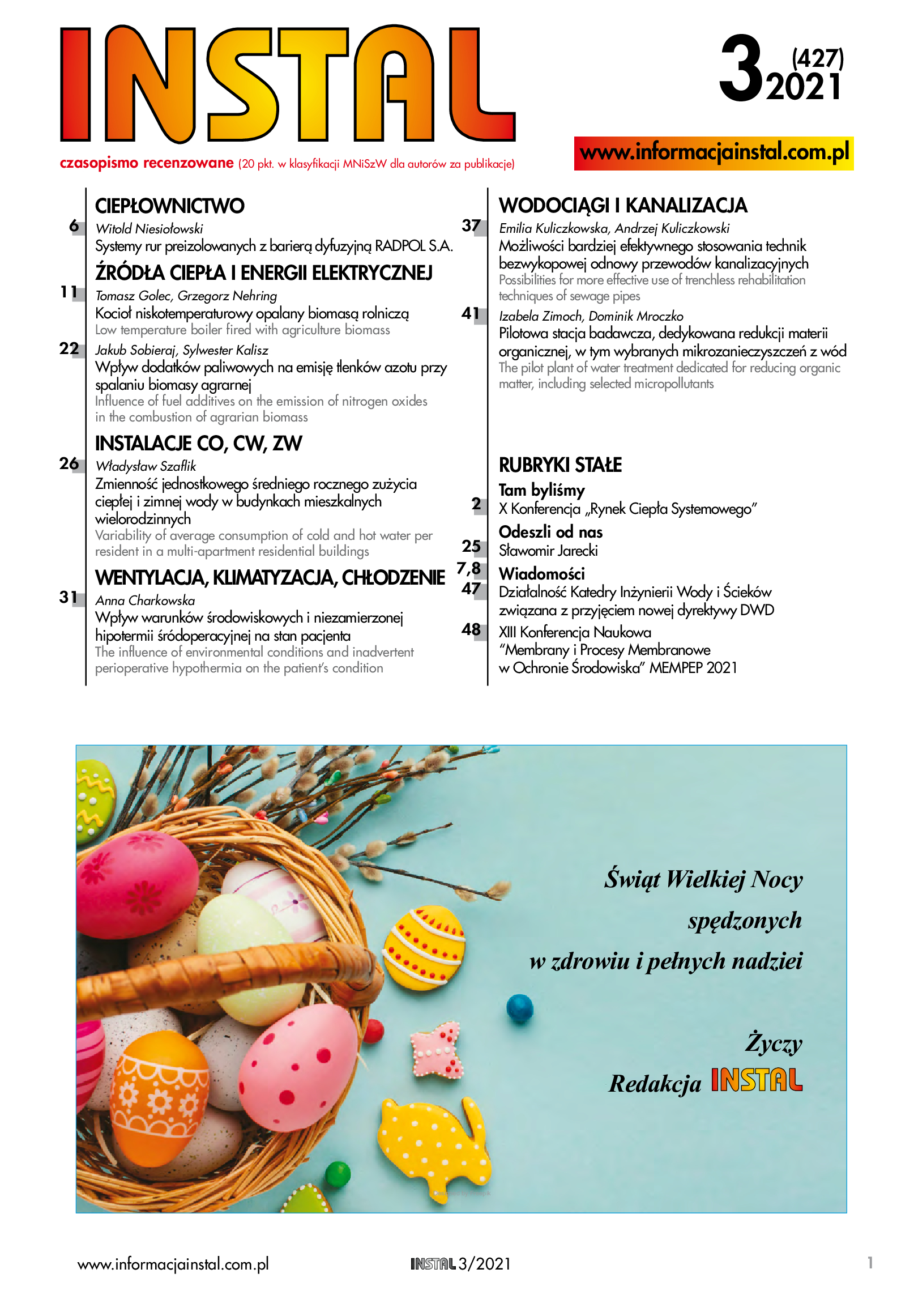
The pilot plant of water treatment dedicated for reducing organic matter, including selected micropollutants
DOI:
https://doi.org/10.36119/15.2021.3.6Keywords:
coagulation, membranes, photolysis, sorbtion, ion exchangeAbstract
Constantly growing interest in micropollutants and with threats resulting from their presence in the aquatic ecosystem may result in stricter regulations related to their monitoring. This paper presents results of the preliminary micropollutants and total organics reduction effectiveness analysis, with processes alternative to classical technologies of water treatment intended for human consumption. The proposed technologies are implemented in a mobile, modular pilot plant also described in this paper. The considered processes were: coagulation, membrane filtration, sorbtion and ion exchange, and photolysis.
Downloads
References
Directive 2000/60/EC of the European Parliament and of the Council of 23 October 2000 establishing a framework for Community action in the field of water policy, Official Journal of the European Communities, 2000, OJ L 327, 22.12.2000, p. 1–73.
Directive 2013/39/EU of the European Parliament and of the Council of 12 August 2013 amending Directives 2000/60/EC and 2008/105/EC as regards priority substances in the field of water policy, Official Journal of the European Communities, 2013, OJ L 226, 24.8.2013, p. 1–17.
Dyrektywa Parlamentu Europejskiego i Rady (UE) 2020/2184 z dnia 16 grudnia 2020 r. w sprawie jakości wody przeznaczonej do spożycia przez ludzi, 23.12.2020 r., L 435/1
Y. Luo, W. Guo, H.H Ngo, L.D Nghiem, F.I Hai, J. Zhang, S. Liang, X.C. Wang, A review on the occurrence of micropollutants in the aquatic environment and their fate and removal during wastewater treatment, Sci
Total Environ, 473-474 (2014) 619-641
Downloads
Published
License

This work is licensed under a Creative Commons Attribution 4.0 International License.
Authors retain copyright and grant the journal the right of first publication, with the work simultaneously licensed under a Creative Commons Attribution 4.0 International License, which permits others to share the work with appropriate acknowledgment of the authorship and initial publication in this journal.