
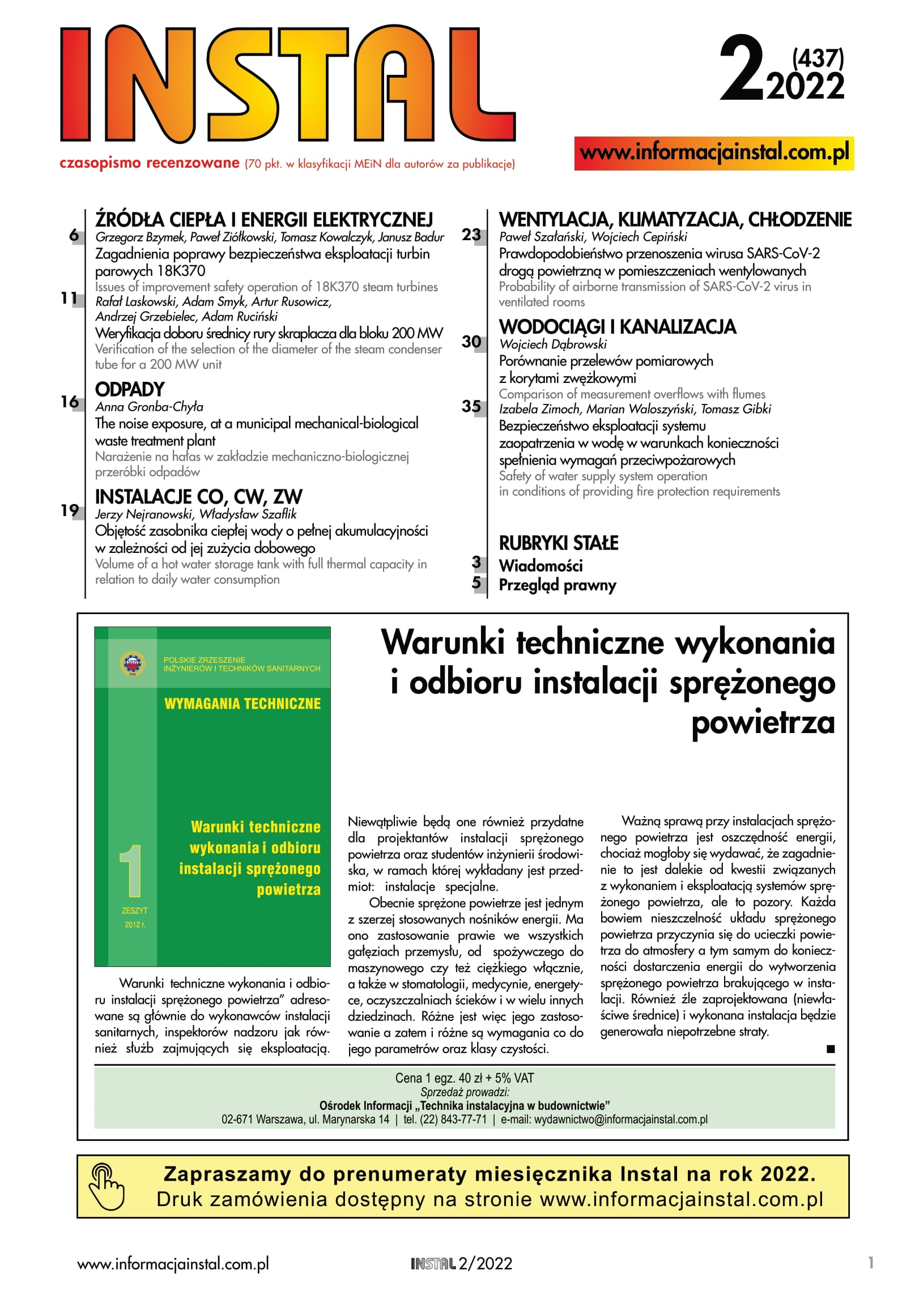
Probability of airborne transmission of SARS-CoV-2 virus in ventilated rooms
DOI:
https://doi.org/10.36119/15.2022.2.5Keywords:
ventilation, outdoor air, HVAC, SARS-CoV-2 coronavirus, Delta variant, Omicron variant, COVID-19Abstract
Using the Wells-Riley model, for different types of rooms, the probability of airborne transmission and reproduction number of SARS-CoV-2 coronavirus (together with Delta and Omicron variants) depending on the type of ventilation and outdoor air flow rate were determined. The analyses were carried out for air flows assumed in the literature and Polish regulations for particular types of rooms and for the permissible or standard number of persons occupying them. Various scenarios was also determined and considered assuming typical time of occupancy in particular types of rooms. The influence of safety rules was also determined and the use of protective masks on the COVID-19 disease transmission by air in rooms
Downloads
References
E. and M. G. EMG, “Role of Ventilation in Controlling SARS-CoV-2 Transmission,” Sage, pp. 2–33, 2020, [Online]. Available: https://www.gov.uk/government/publications/emg-role-of-ventilation-in-controlling-
sars-cov-2-transmission-30-september-2020
L. Morawska at al., “How can airborne transmission of COVID-19 indoors be minimised?,” Environ. Int., vol. 142, no. April, 2020, doi: 10.1016/j.envint.2020.105832.
A. J. Vol and F. Busato, “Remarks on the air recirculation in HVAC systems during the SARS-CoV-2 outbreak : the case of all-air ducted plants,” pp. 50–55.
Downloads
Published
Issue
Section
Categories
License

This work is licensed under a Creative Commons Attribution 4.0 International License.
Authors retain copyright and grant the journal the right of first publication, with the work simultaneously licensed under a Creative Commons Attribution 4.0 International License, which permits others to share the work with appropriate acknowledgment of the authorship and initial publication in this journal.