
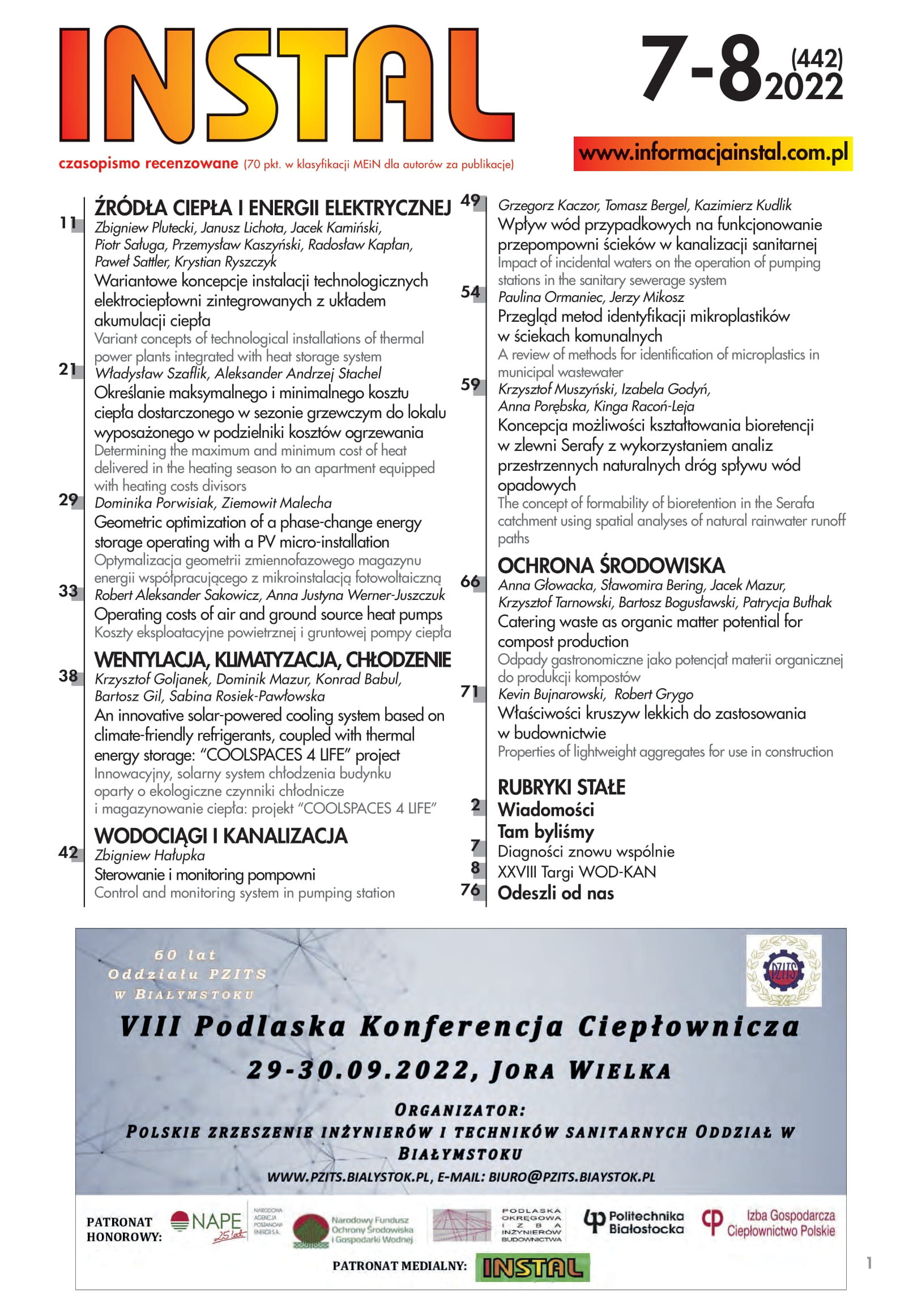
Operating costs of air and ground source heat pumps
DOI:
https://doi.org/10.36119/15.2022.7-8.4Keywords:
operating cost, seasonal coefficient of performance, upper heat source, ground source heat pump, air source heat pumpAbstract
This study aims to determine how the variable operating parameters affect the efficiency and operating costs of the heat pump. A single-family house with a design heat load of 4,3 kW located in climate zone IV in Bialystok is analysed. The analysis concerns a brine-to-water heat pump and an air-to-water heat pump. Three values of bivalent temperature are assumed for the air source heat pump: – 10, – 9 and – 8°C. Five values of heating water temperature are considered: 35, 40, 45, 50 and 55°C. The basis for calculating the heat output and electricity consumption of the heat pumps is the outside air temperature determined for each hour of the heating season in the statistical year. The SCOP values are calculated. Electricity consumption and its cost are determined according to three tariffs offered by PGE: G11, G12 and G12w. A ground source heat pump ensures the lowest operating costs and highest SCOP values. In an air source heat pump the lower the bivalent temperature, the lower the operating costs. The most favourable electricity tariff is the weekend tariff G12w. The 24-hour tariff G11 with identical charges during the day and night is not recommended to use for heating purposes
Downloads
References
GUS. Energia ze źródeł odnawialnych w 2020 r., stat.gov.pl (access data 20.03.2022).
Anweiler S., Masiukiewicz M. (2018). Experimental based determination of SCOP coefficient for a ground-water heat pump. E3S Web Conf. Volume 44, 2018 10th Conference on Interdisciplinary Problems in Environmental Protection and Engineering EKO-DOK 2018.
Dąbrowski J., Hutnik E. (2015). Badania efektywności gruntowej pompy ciepła pracującej na potrzeby centralnego ogrzewania, Instal 11/2015, s. 32-35.
Downloads
Published
Issue
Section
Categories
License

This work is licensed under a Creative Commons Attribution 4.0 International License.
Authors retain copyright and grant the journal the right of first publication, with the work simultaneously licensed under a Creative Commons Attribution 4.0 International License, which permits others to share the work with appropriate acknowledgment of the authorship and initial publication in this journal.