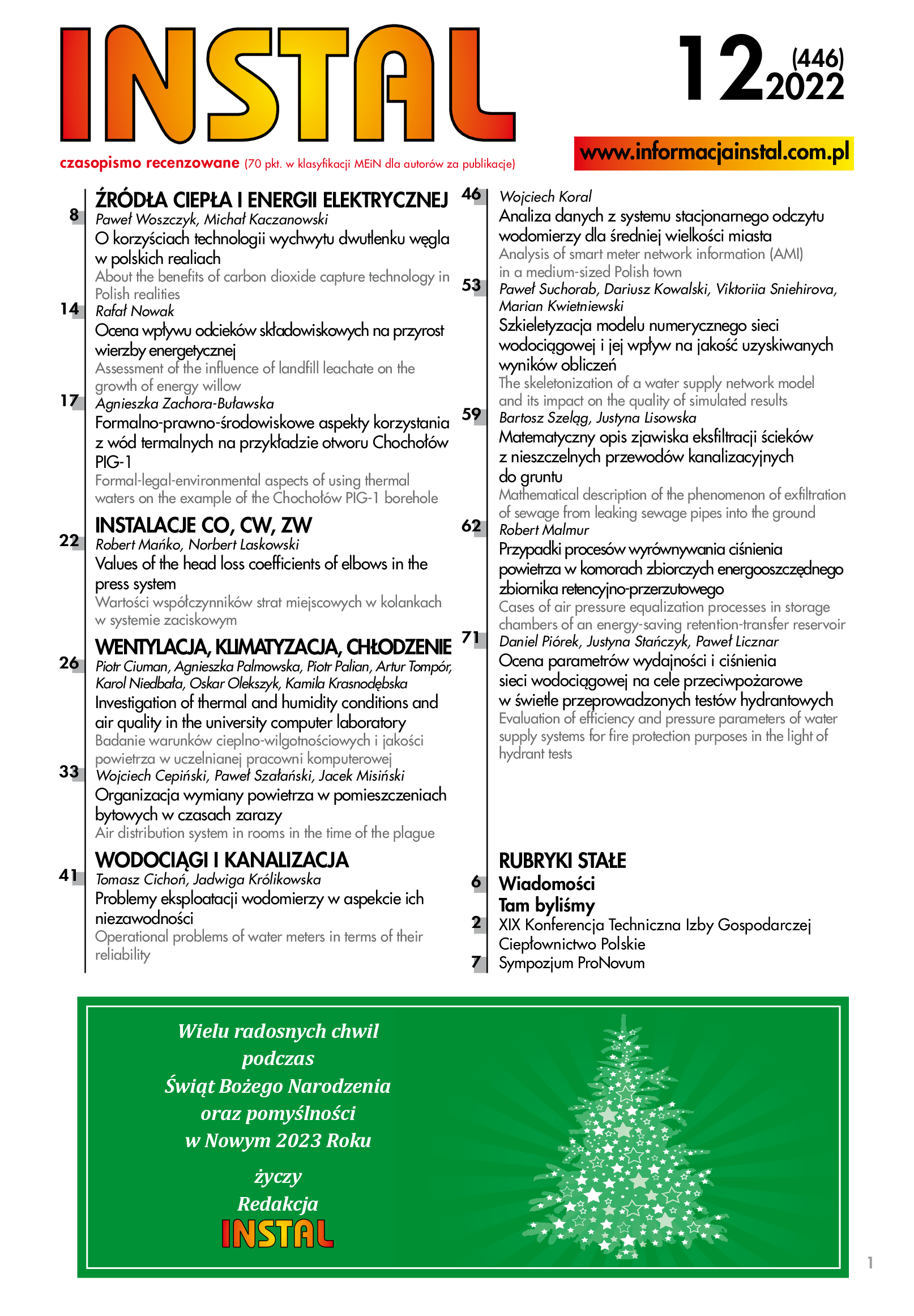
Air distribution system in rooms in the time of the plague
DOI:
https://doi.org/10.36119/15.2022.12.6Keywords:
coronavirus, SARS-CoV-2, COVID-19, ventilation, HVACAbstract
The article indicates factors that increase and decrease the risk of airborne transmission of the pathogen in the room, using the SARS-CoV-2 experience as an example. In particular, the influence of the organization of air exchange in rooms on the risk of pathogen transmission was discussed, in dangerous situations – the presence of a sick person who may be a potential source of infection. Commonly used systems of organization of air exchange in rooms were analysed in terms of the possibility of the spread of contaminants or pathogens and their effective removal or elimination. The influence of devices such as air conditioners, portable fans and air purifiers was also considered. The most favourable solutions were identified, in line with the new paradigm of designing safe installations resulting from the coronavirus pandemic.
Downloads
References
REHVA, “REHVA COVID-19 guidance document, April 3, 2020”.
Eurovent Middle East, “COVID-19 Recommendations for Air Filtration and Ventilation,” 2000.
Environmental and Modelling Group, “Role of Ventilation in Controlling SARS-CoV-2 Transmission,” Sage, 2020, [Online]. Available: https://www.gov.uk/government/publications/emg-role-of-ventilation-in-controlling-sars-cov-2-transmission-30-september-2020
L. Morawska at al., “How can airborne transmission of COVID-19 indoors be minimised?,” Environ. Int., vol. 142, no. April, 2020, doi: 10.1016/j.envint.2020.105832.
Downloads
Published
Issue
Section
Categories
License

This work is licensed under a Creative Commons Attribution 4.0 International License.
Authors retain copyright and grant the journal the right of first publication, with the work simultaneously licensed under a Creative Commons Attribution 4.0 International License, which permits others to share the work with appropriate acknowledgment of the authorship and initial publication in this journal.