
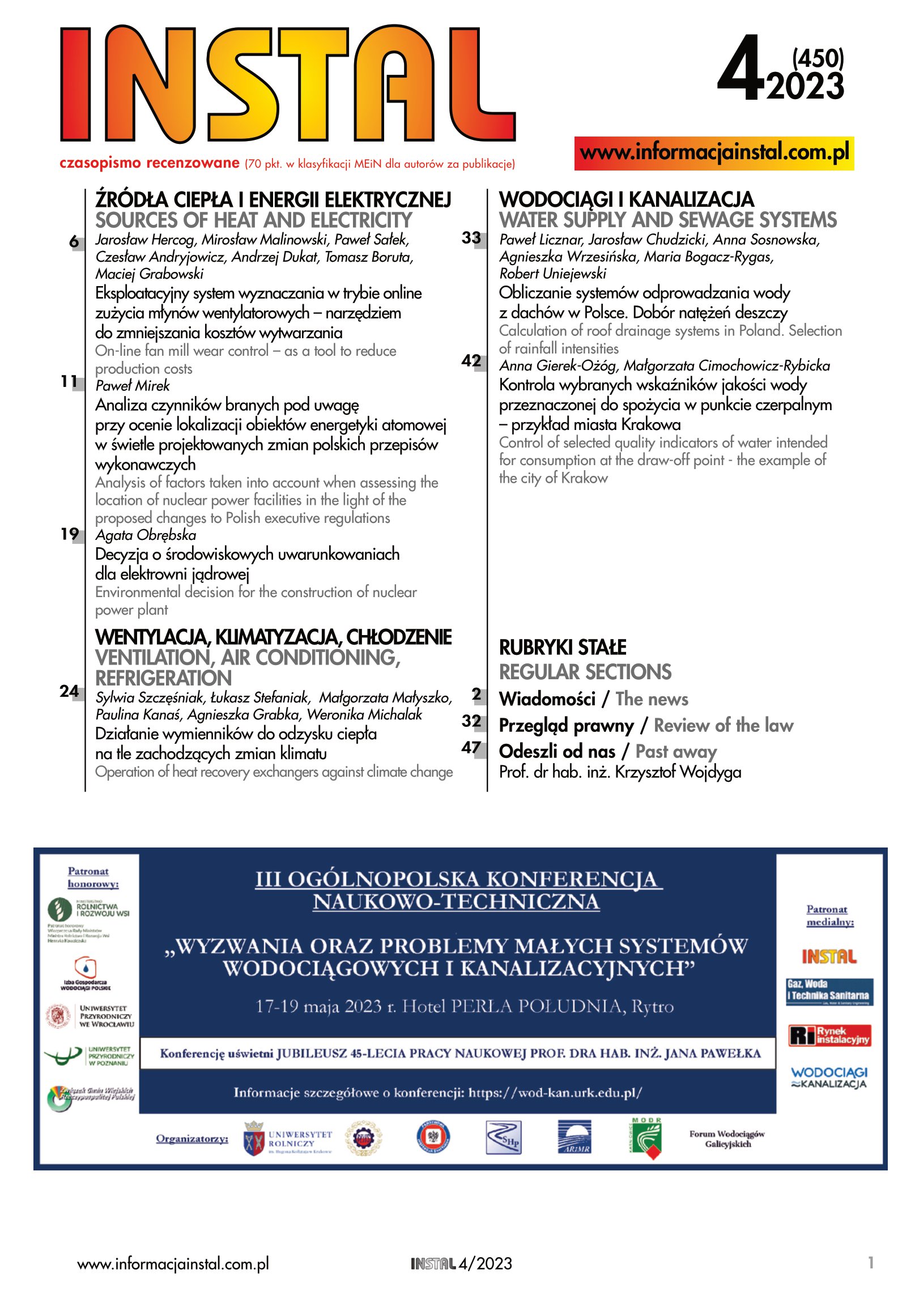
Operation of heat recovery exchangers against climate change
DOI:
https://doi.org/10.36119/15.2023.4.4Keywords:
ventilation, temperature efficiency, heat exchanger, air cooler, heating coil, energy, free-coolingAbstract
The article discusses the influence of climate change in Wrocław on the operation of heat recovery exchangers. The main focus is the influence of heat recovery temperature efficiency regulation on the cooler and heater operation time and thus on the energy required for their operation. A typical HVAC system with heat recovery system operation is evaluated using a t-tz chart. To present ongoing climate changes, a comparison of design data from the Dz.U. 2002 nr 75 poz. 690 is made, with later amendments and data released by the Ministry of Investment and Development (1971–2000) and data from 1996–2022 available at meteomodel.pl. The article provides data that confirm that climate changes caused an increase in outdoor temperature air by 5 K that should be used as design parameters (compared to regulations) for the winter and summer conditions in the city of Wrocław. Currently, the duration of outdoor air temperature (mean values for the period 1996-2022) in the range of 0–17oC is shown to be approximately 68% of the year. Therefore, the possibility of using free-cooling is significantly increased, influencing the reduction of the energy required for cooling purposes.
Downloads
References
Larsen MAD, Petrović S, Radoszynski AM, McKenna R, Balyk O. Climate change impacts on trends and extremes in future heating and cooling demands over Europe. Energy Build. 2020;226:110397. doi:10.1016/j.enbuild.2020.110397
Fan M, Fu Z, Wang J, et al. A review of different ventilation modes on thermal comfort, air quality and virus spread control. Build Environ. 2022;212:108831. doi:10.1016/j.buildenv. 2022.108831
Ciuman P, Palmowska A, Palian P, et al. Investigation of thermal and humidity conditions and air quality in the university computer laboratory. Instal. 2022;12:26-32. doi:10.36119/15.2022.12.5
Downloads
Published
Issue
Section
Categories
License

This work is licensed under a Creative Commons Attribution 4.0 International License.
Authors retain copyright and grant the journal the right of first publication, with the work simultaneously licensed under a Creative Commons Attribution 4.0 International License, which permits others to share the work with appropriate acknowledgment of the authorship and initial publication in this journal.