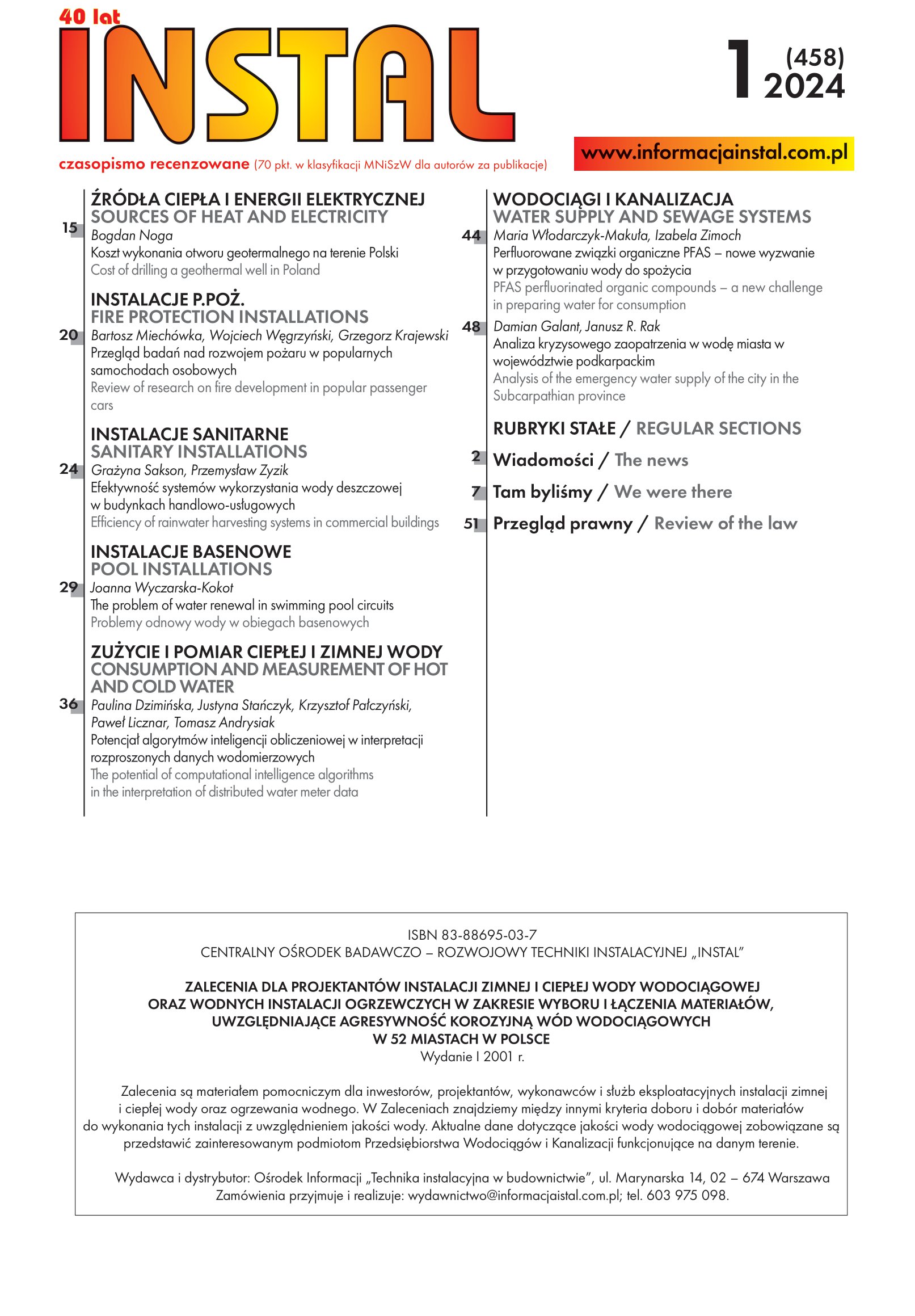
The problem of water renewal in swimming pool circuits
DOI:
https://doi.org/10.36119/15.2024.1.4Keywords:
water renewal, swimming pool, water closed circuit, swimming pool water quality, supplementary waterAbstract
The problem of water renewal in swimming pools is mainly related to the concentration of some contaminants (with the quality of swimming pool water) and to the need for water to supplement losses in the closed swimming pool circuit (volume of swimming pool water). This problem is presented on the basis of physicochemical analysis of pool water samples (taken every two hours during one day and taken daily during one week) and the amount of supplementary water demand (water metre reading) depending on attendance and in relation to rational water management for a sports-type pool. The results were compared with the guidelines of the Swimming Pool Water Quality Decree and the recommendations of DIN 19643. Pool water quality parameters, such as: absorbance, redox potential, combined chlorine, nitrates, and chlorides, could be considered as indicative for the daily assessment
of water, and depending on their value, supplement the circuit with water from the water supply network. The amount of supplementary water used (an average of 40.6 L/bather day) exceeded the DIN 19643 recommendations by 26%. To rationalise water management, a water quality analysis should be carried out with the consumption of supplementary water reduced to 30 L/bather day (that is, on average 11.5 m3/day instead of 15.6 m3/day).
Downloads
References
J. Wyczarska-Kokot, M. Dudziak, A. Lempart, Effects of modernization of the water treatment system in a selected swimming pool, Environment Protection Engineering. 45 (2019) 31–43. https://doi.org/10.5277/epe190103.
J. Wyczarska-Kokot, Wieloaspektowa analiza parametrów wpływających na jakość wód basenowych, Wydawnictwo Politechniki Śląskiej, Gliwice, 2020.
B. Skibinski, S. Uhlig, P. Müller, I. Slavik, W. Uhl, Impact of different combinations of water treatment processes on the concentration of disinfection byproducts and their precursors in swimming pool water, Environ Sci Technol. 53 (2019) 8115–8126. https://doi.org/10.1021/acs.est.9b00491
Downloads
Published
License

This work is licensed under a Creative Commons Attribution 4.0 International License.
Authors retain copyright and grant the journal the right of first publication, with the work simultaneously licensed under a Creative Commons Attribution 4.0 International License, which permits others to share the work with appropriate acknowledgment of the authorship and initial publication in this journal.