
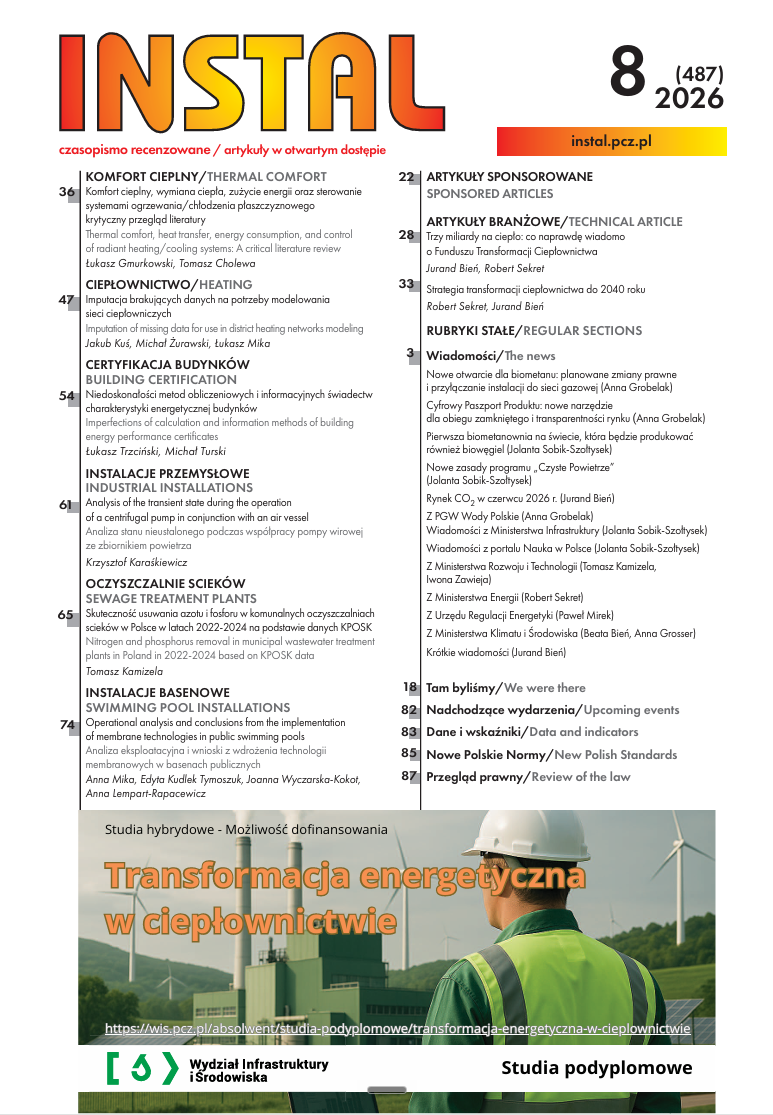
Komfort cieplny, wymiana ciepła, zużycie energii oraz sterowanie systemami ogrzewania/chłodzenia płaszczyznowego - krytyczny przegląd literatury
DOI:
https://doi.org/10.17512/INSTAL.2026.08.01Słowa kluczowe:
podłoga grzewcza, ogrzewanie płaszczyznowe, chłodzenie płaszczyznowe, strategie sterowania, efektywność energetycznaAbstrakt
Systemy ogrzewania i chłodzenia płaszczyznowego (RHC Radiant Heating and Cooling) zyskują na popularności dzięki licznym zaletom, takim jak wysoki komfort cieplny, niskie zużycie energii, cicha praca, oszczędność miejsca i inne. W związku z tym przeprowadzono już wiele badań i analiz nad systemami RHC celem ich rozwoju i optymalizacji tak, aby mogły stanowić odpowiedź na ambitne cele Uni Europejskiej w zakresie efektywności energetycznej oraz zmieniające się uwarunkowania energetyczne. W niniejszym opracowaniu przeprowadzono kompleksowy przegląd literatury dotyczącej systemów RHC, pod kątem komfortu cieplnego i ich efektywności energetycznej z wielu punktów widzenia przy użyciu różnych strategii sterowania ich pracą. Wyniki wykazały, że systemy RHC są nieustannie rozwijane, modyfikowane i udoskonalane, a dobór odpowiedniej strategii sterowania może rozwiązać problem efektywności energetycznej, jednocześnie poprawiając komfort cieplny wewnątrz pomieszczeń. Jednakże powszechnie stosowane algorytmy i strategie sterowania często opierają się na parametrach pracy systemu w stanie ustalonym. Ponadto w systemach RHC wciąż stosuje się typowe rozwiązanie polegające na regulacji temperatury czynnika zasilającego (regulacja jakościowa) w ujęciu centralnym (w źródle) w połączeniu z regulacją przepływu czynnika (regulacja ilościowa) w ujęciu lokalnym (w obrębie poszczególnych pętli ogrzewania/chłodzenia podłogowego). W dobie rosnących kosztów energii i globalnych wyzwań związanych z jej dostępnością, właściwa meto da sterowania systemem RHC stała się kluczowym elementem dla wielu odbiorców i priorytetem dla użytkowników. Aby rozwiązać problemy związane ze zużyciem i oszczędzaniem energii, konieczne jest opracowanie i wdrożenie unikalnych, nowoczesnych technologii sterowania dla systemów RHC. Na podstawie przeglądu literatury zidentyfikowano luki badawcze, obejmujące m.in. brak analiz systemów RHC pod kątem efektywności energetycznej i komfortu cieplnego w kontekście zastosowania regulacji jakościowej zarówno w ujęciu centralnym, jak i lokalnym w połączeniu z różnymi rodzajami sterowania. Rozwiązanie to powinno pozwolić na przezwyciężenie ograniczeń systemów RHC i rozszerzenie zakresu ich stosowania na różne typy budynków oraz strefy klimatyczne.
Pobrania
Bibliografia
[1] Komisja Europejska. (2019). Europejski Zielony Ład (Komunikat Komisji do Parlamentu Europejskiego,
Rady Europejskiej, Rady, Europejskiego Komitetu Ekonomiczno-Społecznego i Komitetu Regionów, COM(2019) 640 final).
[2] Rhee, K.-N., Olesen, B. W., & Kim, K. W. (2017). Ten questions about radiant heating and cooling systems. Building and Environment, 112, 367–381. https://doi.org/10.1016/j.buildenv.2016.11.030
[3] Olesen, B. W. (2008). Radiant floor cooling systems. ASHRAE Journal, 50(9), 16–22.
[4] Babiak, J., Olesen, B. W., & Petras, D. (2007). Low temperature heating and high temperature cooling systems (REHVA Guidebook No. 7). Federation of European Heating, Ventilation and Air Conditioning Associations..
[5] Polski Komitet Normalizacyjny. (2019). Charakterystyka energetyczna budynków — Wentylacja budynków — Część 1: Parametry wejściowe środowiska wewnętrznego do projektowania i oceny charakterystyki energetycznej budynków w odniesieniu do jakości powietrza wewnętrznego, środowiska cieplnego, oświetlenia i akustyki — Moduł M1-6 (Norma Nr PN-EN 16798-1:2019-06).
[6] American Society of Heating, Refrigerating and Air-Conditioning Engineers. (2004). Thermal environmental conditions for human occupancy (ASHRAE Standard 55-2004).
[7] Polski Komitet Normalizacyjny. (2006). Ergonomia środowiska termicznego - Analityczne wyznaczanie i interpretacja komfortu termicznego z zastosowaniem obliczania wskaźników PMV i PPD oraz kryteriów lokalnego komfortu termicznego (Norma Nr PN-EN ISO 7730:2006).
[8] Myhren, J. A., & Holmberg, S. (2008). Flow patterns and thermal comfort in a room with panel, floor and wall heating. Energy and Buildings, 40(4), 524–536. https://doi.org/10.1016/j.enbuild.2007.04.011
[9] Tian, Z., & Love, J. A. (2009). Energy performance optimization of radiant slab cooling using building simulation and field measurements. Energy and Buildings, 41(3), 320–330. https://doi.org/10.1016/j.enbuild.2008.10.002
[10] An, J.-Y., Kim, S., Kim, H.-J., & Seo, J. (2010). Emission behavior of formaldehyde and TVOC from engineered flooring in under heating and air circulation systems. Building and Environment, 45(8), 1826–1833. https://doi.org/10.1016/j.buildenv.2010.02.012
[11] Schellen, L., Timmers, S., Loomans, M., Nelissen, E., Hensen, J. L. M., & van Marken Lichtenbelt, W. (2012). Downdraught assessment during design: Experimental and numerical evaluation of a rule of thumb. Building and Environment, 57, 290–301. https://doi.org/10.1016/j.buildenv.2012.04.011
[12] Kang, D. H., Choi, D. H., Seong, Y.-B., Yeo, M. S., & Kim, K. W. (2013). A numerical simulation of VOC emission and sorption behaviors of adhesive bonded materials under floor heating condition. Building and Environment, 68, 193–201. https://doi.org/10.1016/j.buildenv.2013.06.013
[13] Khorasanizadeh, H., Sheikhzadeh, G. A., Azemati, A. A., & Shirkavand Hadavand, B. (2014). Numerical study of air flow and heat transfer in a two-dimensional enclosure with floor heating. Energy and Buildings, 78, 98–104. https://doi.org/10.1016/j.enbuild.2014.04.007
[14] Lin, B., Wang, Z., Sun, H., Zhu, Y., & Ouyang, Q. (2016). Evaluation and comparison of thermal comfort of convective and radiant heating terminals in office buildings. Building and Environment, 106, 91–102. https://doi.org/10.1016/j.buildenv.2016.06.015
[15] Zhang, C., Pomianowski, M., Heiselberg, P. K., & Yu, T. (2020). A review of integrated radiant heating/cooling with ventilation systems- Thermal comfort and indoor air quality. Energy and Buildings, 223, artykuł 110094. https://doi.org/10.1016/j.enbuild.2020.110094
[16] Qi, D., Liu, Y., Zhao, C., Dong, Y., Song, B., & Li, A. (2024). Thermal response and performance evaluation of floor radiant heating system based on fuzzy logic control. Energy and Buildings, 313, artykuł 114232. https://doi.org/10.1016/j.enbuild.2024.114232
[17] Polski Komitet Normalizacyjny. (2021). Wbudowane płaszczyznowe wodne systemy ogrzewania i chłodzenia - Część 2: Wodne wbudowane systemy ogrzewania i chłodzenia płaszczyznowego -- Część 2: Ogrzewanie podłogowe: Metody określania mocy cieplnej z zastosowaniem obliczeń i badań eksperymentalnych (Norma Nr PN-EN 1264-2:2021-10)
[18] Cholewa, T., Rosiński, M., Spik, Z., Dudzińska, M. R., & Siuta-Olcha, A. (2013). On the heat transfer coefficients between heated/cooled radiant floor and room. Energy and Buildings, 66, 599–606. https://doi.org/10.1016/j.enbuild.2013.07.065
[19] Rhee, K.-N., & Kim, K. W. (2015). A 50 year review of basic and applied research in radiant heating and cooling systems for the built environment. Building and Environment, 91, 166–190. https://doi.org/10.1016/j.buildenv.2015.03.040
[20] Chiang, W.-H., Wang, C.-Y., & Huang, J.-S. (2012). Evaluation of cooling ceiling and mechanical ventilation systems on thermal comfort using CFD study in an office for subtropical region. Building and Environment, 48, 113–127. https://doi.org/10.1016/j.buildenv.2011.09.002
[21] Park, S. H., Chung, W. J., Yeo, M. S., & Kim, K. W. (2014). Evaluation of the thermal performance of a Thermally Activated Building System (TABS) according to the thermal load in a residential building. Energy and Buildings, 73, 69–82. https://doi.org/10.1016/j.enbuild.2014.01.008
[22] Bojić, M., Cvetković, D., & Bojić, L. (2015). Decreasing energy use and influence to environment by radiant panel heating using different energy sources. Applied Energy, 138, 404–413. https://doi.org/10.1016/j.apenergy.2014.10.063
[23] Jeong, J.-W., & Mumma, S. A. (2007). Practical cooling capacity estimation model for a suspended metal ceiling radiant cooling panel. Building and Environment, 42(9), 3176–3185. https://doi.org/10.1016/j.buildenv.2006.08.006
[24] Zhao, K., Liu, X.-H., & Jiang, Y. (2013). Application of radiant floor cooling in a large open space building with high-intensity solar radiation. Energy and Buildings, 66, 246–257. https://doi.org/10.1016/j.enbuild.2013.07.014
[25] Zhao, K., Liu, X.-H., & Jiang, Y. (2015). Cooling capacity prediction of radiant floors in large spaces of an airport. Solar Energy, 113, 221–235. https://doi.org/10.1016/j.solener.2015.01.003
[26] Kim, K. W., & Olesen, B. W. (2015). Radiant heating and cooling systems: part 1. ASHRAE Journal, 57(2), 28–37.
[27] Żukowski, M. (2009). Ogrzewanie podłogowe. Oficyna Wydawnicza Politechniki Białostockiej
[28] Verein Deutscher Ingenieure. (2018). Economic efficiency of building installations - Energy effort of benefit transfer for water heating systems (Standard No. VDI 2067-Part 20)
[29] Sattari, S., & Farhanieh, B. (2006). A parametric study on radiant floor heating system performance. Renewable Energy, 31(10), 1617–1626. https://doi.org/10.1016/j.renene.2005.09.009
[30] Hasan, A., Kurnitski, J., & Jokiranta, K. (2009). A combined low temperature water heating system consisting of radiators and floor heating. Energy and Buildings, 41(5), 470–479. https://doi.org/10.1016/j.enbuild.2008.11.016
[31] Fonseca Díaz, N., & Cuevas, C. (2010). Testing and thermal modeling of radiant panels systems as commissioning tool. Energy Conversion and Management, 51(12), 2663–2677. https://doi.org/10.1016/j.enconman.2010.06.001
[32] Rastegarpour, S., Gros, S., & Ferrarini, L. (2020). MPC approaches for modulating air-to-water heat pumps in radiant-floor buildings. Control Engineering Practice, 95, artykuł 104209. https://doi.org/10.1016/j.conengprac.2019.104209
[33] Joe, J., & Karava, P. (2019). A model predictive control strategy to optimize the performance of radiant floor heating and cooling systems in office buildings. Applied Energy, 245, 65–77. https://doi.org/10.1016/j.apenergy.2019.03.209
[34] Hu, M., Xiao, Fu, Jørgensen, J. B., & Li, R. (2019). Price-responsive model predictive control of floor heating systems for demand response using building thermal mass. Applied Thermal Engineering, 153, 316–329. https://doi.org/10.1016/j.applthermaleng.2019.02.10
[35] Chen, Q., Li, N., & Feng, W. (2021). Model predictive control optimization for rapid response and energy efficiency based on the state-space model of a radiant floor heating system. Energy and Buildings, 238, artykuł 110832. https://doi.org/10.1016/j.enbuild.2021.110832
[36] Liang, X., Shim, J., & Song, D. (2025). A simple and efficient machine-learning based approach for optimal heating control of radiant floor heating systems: Proposal and validation. Building and Environment, 272, artykuł 112666. https://doi.org/10.1016/j.buildenv.2025.112666
[37] Liu, Y., Nan, X., Han, H., & Li, J. (2024). The variable water temperature control strategy of the air-source heat pump compatible with floor heating system for an apartment. Journal of Building Engineering, 90, artykuł 109440. https://doi.org/10.1016/j.jobe.2024.109440
[38] Shin, M.-S., Rhee, K.-N., & Jung, G.-J. (2020). Optimal heating start and stop control based on the inferred occupancy schedule in a household with radiant floor heating system. Energy and Buildings, 209, artykuł 109737. https://doi.org/10.1016/j.enbuild.2019.109737
[39] Zhang, D., Cai, N., Cui, X., Xia, X., Shi, J., & Huang, X. (2019). Experimental investigation on model predictive control of radiant floor cooling combined with underfloor ventilation system. Energy, 176, 23–33. https://doi.org/10.1016/j.energy.2019.03.102
[40] Cesari, S., Emmi, G., & Bottarelli, M. (2022). A weather forecast-based control for the improvement of PCM enhanced radiant floors. Applied Thermal Engineering, 206, Artykuł 118119. https://doi.org/10.1016/j.applthermaleng.2022.118119
Opublikowane
Licencja
Prawa autorskie (c) 2026 Łukasz Gmurkowski, Tomasz Cholewa (Autor)

Utwór dostępny jest na licencji Creative Commons Uznanie autorstwa 4.0 Międzynarodowe.
Authors retain copyright and grant the journal the right of first publication, with the work simultaneously licensed under a Creative Commons Attribution 4.0 International License, which permits others to share the work with appropriate acknowledgment of the authorship and initial publication in this journal.