
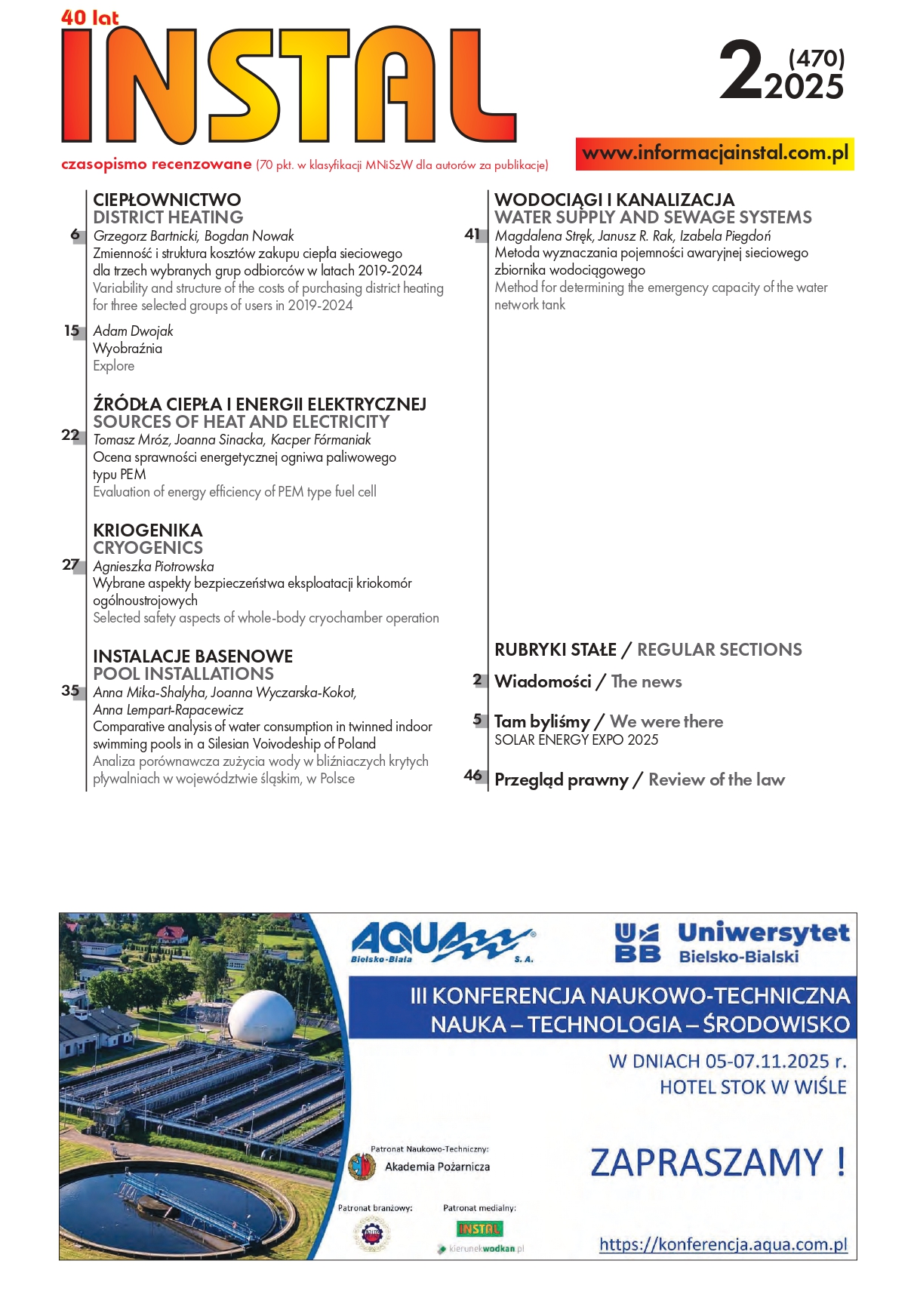
Selected safety aspects of whole-body cryochamber operation
DOI:
https://doi.org/10.36119/15.2025.2.4Keywords:
cryochamber, risk analysis, electrochemical oxygen sensorAbstract
Cryochambers (cryogenic chambers) are devices designed and used for cryotherapy. The treatment involves exposing the human body to extremely low temperature (below – 100°C) for a short period of time. Cryochambers have been designed and manufactured for over 35 years in Poland. They have usually been used in hospitals and rehabilitation centres. Recently, low-temperature sessions have been lately recognised as an effective method of regeneration and wellness. Therefore, they are becoming available in gyms and beauty centres. Achieving such low temperatures requires the use of gases with properties that may pose a potential risk to cryochamber users. This article presents methods of achieving cryotherapy temperatures, describes the properties of working fluids, safety analysis and risk assessment of cryochamber operation. Special attention has been paid to the cryochambers supplied with
liquid nitrogen.
Downloads
References
Bouzigon R., Arfaoui A., Grappe F., Raviera G., Jarlot B., Dugue B., Validation of a new whole-body cryotherapy chamber based on forced convection, Journal of Thermal Biology, 2017
Bouzigon R., Grappe F., Ravier G., Dugue B., Whole – and partial-body cryotherapy: Current technologies and practical applications, Journal of Thermal Biology, 2016
Cauttell S., Hammond L., Langdon D., Costello J., Individualising the exposure of – 110C whole body cryotherapy: The effects of sex and body composition, Journal of Thermal Biology, 2017
Downloads
Published
License

This work is licensed under a Creative Commons Attribution 4.0 International License.
Authors retain copyright and grant the journal the right of first publication, with the work simultaneously licensed under a Creative Commons Attribution 4.0 International License, which permits others to share the work with appropriate acknowledgment of the authorship and initial publication in this journal.