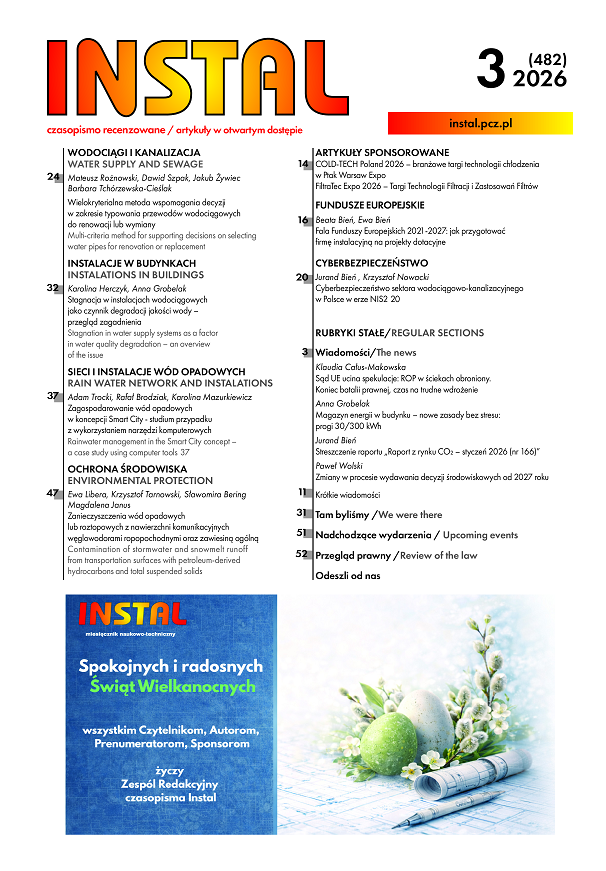
Stagnation in water supply systems as a factor in water quality degradation – an overview of the issue
DOI:
https://doi.org/10.17512/INSTAL.2026.03.02Keywords:
stagnation, water system, water quality, biofilm, building water managementAbstract
Stagnation in internal water systems is one of the key factors negatively affecting water quality for consumers. Under conditions of low flow and long residence time, a decrease in disinfectant levels, an increase in microorganism counts, and changes in the system's microbiome structure can be observed, along with an increased risk of metal release and deterioration of organoleptic properties (i.e., taste and odor). This article presents the mechanisms of water quality degradation caused by stagnation, typical locations of stagnant zones, and the role of temperature in shaping microbiological risk. The following section discusses contemporary design-related conditions, presents an example scenario of water quality degradation in a new building, and outlines the responsibilities of the designer and the facility manager. The importance of a risk-based approach and water system management programs is emphasized.
Downloads
References
American Water Works Association, & International Association of Plumbing and Mechanical Officials. (2020). Responding to water stagnation in buildings with reduced or no water use: A framework for building managers. https://www.awwa.org/wp-content/uploads/responding-to-water-stagnation-in-buildings.pdf
Proctor, C. R., Rhoads, W. J., Keane, T., Salehi, M., Hamilton, K., Pieper, K. J., Cwiertny, D. M., Prévost, M., & Whelton, A. J. (2020). Considerations for large building water quality after extended stagnation. AWWA Water Science, 2(4), e1186. https://doi.org/10.1002/aws2.1186
Ra, K., Parks, J., Proctor, C. R., Rhoads, W. J., & Edwards, M. A. (2024). Four buildings and a flush: Lessons from degraded water quality and recommendations on building water management. Environmental Science and Ecotechnology, 18, 100314. https://doi.org/10.1016/j.ese.2024.100314
U.S. Environmental Protection Agency. (2020). Maintaining or restoring water quality in buildings with low or no use. Retrieved January 2026, from https://www.epa.gov/sites/default/files/2020-05/documents/final_maintaining_building_water_quality_5.6.20-v2.pdf
Centers for Disease Control and Prevention. (2024, March 15). Overview of water management programs. https://www.cdc.gov/control-legionella/php/wmp/index.html
Angert, D. M., Ley, C., Ra, K., Noh, Y., Zyaykina, N., Montagnino, E., Wei, R., Whelton, A. J., & Proctor, C. R. (2023). Water quality during extended stagnation and flushing in a college residential hall. Environmental Science: Water Research & Technology, 9(12), 3484–3496. https://doi.org/10.1039/D3EW00038A
World Health Organization. (2023). Water safety plan manual: Step-by-step risk management for drinking-water suppliers (2nd ed.). https://www.who.int/publications/i/item/9789240067691
Matuszewska, R., & Guśpiel, A. (2024). Biofilm w wewnętrznych systemach wodociągowych – zagrożenia mikrobiologiczne i wpływ na jakość wody. Instal, 464(7–8), 38–43. https://doi.org/10.36119/15.2024.7-8.5
Huang, C. K., Weerasekara, A., Lu, J., Carter, R., Weynberg, K. D., Thomson, R., Bell, S., & Guo, J. (2023). Extended water stagnation in buildings during the COVID-19 pandemic increases the risks posed by opportunistic pathogens. Water Research X, 21, 100201. https://doi.org/10.1016/j.wroa.2023.100201
Greenwald, H. G., Kennedy, L. C., Ehde, A. E., Duan, Y., Olivares, C. I., Kantor, R., & Nelson, K. L. (2022). Is flushing necessary during building closures? A study of water quality and bacterial communities during extended reductions in building occupancy. Frontiers in Water, 4, 958523. https://doi.org/10.3389/frwa.2022.958523
Centers for Disease Control and Prevention. (2024, February 6). Reopening buildings: Building water system guidance. https://www.cdc.gov/control-legionella/php/guidance/building-water-system.html
Gasperi, J., Le Roux, J., Deshayes, S., Ayrault, S., Bordier, L., Boudahmane, L., Budzinski, H., Caupos, E., Caubrière, N., Flanagan, K., Guillon, M., Huynh, N., Labadie, P., Meffray, L., Neveu, P., Partibane, C., Paupardin, J., Saad, M., Varnede, L., & Gromaire, M.-C. (2022). Micropollutants in urban runoff from traffic areas: Target and non-target screening on four contrasted sites. Water, 14(3), 394. https://doi.org/10.3390/w14030394
Nisar, M. A., Ross, K. E., Brown, M. H., Bentham, R., & Whiley, H. (2020). Water stagnation and flow obstruction reduces the quality of potable water and increases the risk of legionelloses. Frontiers in Environmental Science, 8, 611611. https://doi.org/10.3389/fenvs.2020.611611
Rhoads, W. J., Sindelar, M., Margot, C., Graf, N., & Hammes, F. (2022). Variable Legionella response to building occupancy patterns and precautionary flushing. Microorganisms, 10(3), 555. https://doi.org/10.3390/microorganisms10030555
Scanlon, M. M., Gordon, J. L., & Reynolds, K. A. (2023). Building water quality commissioning in healthcare settings: Reducing Legionella and water contaminants utilizing a construction scheduling method. Buildings, 13(10), 2533. https://doi.org/10.3390/buildings13102533
Australian Building Codes Board. (2021). Lead in plumbing products in contact with drinking water: Final regulation impact statement. https://www.abcb.gov.au/sites/default/files/resources/2022/Lead-in-plumbing-products-final-RIS-20210517.pdf
Saetta, D., Richard, R., Leyva, C., Westerhoff, P., & Boyer, T. H. (2021). Data-mining methods predict chlorine residuals in premise plumbing using low-cost sensors. AWWA Water Science, 3(1), e1214. https://doi.org/10.1002/aws2.1214
Czerwińska, K., Kuliński, E., & Grobelak, A. (2025). Preliminary microbiological screening of internal water supply installations considering the material structure of pipelines. Advances in Science and Technology Research Journal, 19(11), 452–465. https://doi.org/10.12913/22998624/208928
Nisar, M. A., Ross, K. E., Brown, M. H., Bentham, R., & Whiley, H. (2023). Stagnation arising through intermittent usage is associated with increased viable but nonculturable Legionella and amoeba hosts in a hospital water system. Frontiers in Cellular and Infection Microbiology, 13, 1190631. https://doi.org/10.3389/fcimb.2023.1190631
Committee on Management of Legionella in Water Systems, Board on Population Health and Public Health Practice, Health and Medicine Division, & National Academies of Sciences, Engineering, and Medicine. (2019). Management of Legionella in water systems. National Academies Press. https://doi.org/10.17226/25474
European Centre for Disease Prevention and Control. (2022). Legionnaires’ disease: Prevention and control in buildings. Retrieved January 13, 2026, from https://www.ecdc.europa.eu/en/legionnaires-disease
Waegenaar, F., Pluym, T., Coene, L., Schelfhout, J., García-Timermans, C., De Gusseme, B., & Boon, N. (2024). Impact of temperature and water source on drinking water microbiome during distribution in a pilot-scale study. npj Clean Water, 7(1), 76. https://doi.org/10.1038/s41545-024-00371-0
Hayward, C., Ross, K. E., Brown, M. H., Bentham, R., & Whiley, H. (2022). The presence of opportunistic premise plumbing pathogens in residential buildings: A literature review. Water, 14(7), 1129. https://doi.org/10.3390/w14071129
Machnik-Słomka, J., Pawłowska, E., Kłosok-Bazan, I., & Goňo, M. (2024). Evaluation of the energy management system in water and wastewater utilities in the context of sustainable development—A case study. Energies, 17(19), 5014. https://doi.org/10.3390/en17195014
Calero Preciado, C., Boxall, J., Soria-Carrasco, V., Martínez, S., & Douterelo, I. (2021). Implications of climate change: How does increased water temperature influence biofilm and water quality of chlorinated drinking water distribution systems? Frontiers in Microbiology, 12, 658927. https://doi.org/10.3389/fmicb.2021.658927
Calero Preciado, C., Soria-Carrasco, V., Boxall, J., & Douterelo, I. (2022). Climate change and management of biofilms within drinking water distribution systems. Frontiers in Environmental Science, 10, 962514. https://doi.org/10.3389/fenvs.2022.962514
Aloraini, S., Alum, A., & Abbaszadegan, M. (2023). Impact of pipe material and temperature on drinking water microbiome and prevalence of Legionella, Mycobacterium, and Pseudomonas species. Microorganisms, 11(2), 352. https://doi.org/10.3390/microorganisms11020352
van der Wielen, P. W. J. J., Dignum, M., Donocik, A., & Prest, E. I. (2023). Influence of temperature on growth of four different opportunistic pathogens in drinking water biofilms. Microorganisms, 11(6), 1574. https://doi.org/10.3390/microorganisms11061574
Almonacid Garrido, M. C., Villanueva-Suárez, M. J., Montes Martín, M. J., Garcia-Alonso, A., & Tenorio Sanz, M. D. (2024). Prevalence and distribution of Legionella in municipal drinking water supply systems in Madrid (Spain) and risk factors associated. Science of the Total Environment, 954, 176655. https://doi.org/10.1016/j.scitotenv.2024.176655
European Parliament, & Council of the European Union. (2020, December 16). Directive (EU) 2020/2184 on the quality of water intended for human consumption (recast). Official Journal of the European Union, L 435, 1–62. https://eur-lex.europa.eu/eli/dir/2020/2184/oj/eng
Minister Zdrowia. (2017, December 7). Rozporządzenie Ministra Zdrowia z dnia 7 grudnia 2017 r. w sprawie jakości wody przeznaczonej do spożycia przez ludzi (Dz.U. 2017 poz. 2294). https://www.dziennikustaw.gov.pl/du/2017/2294
Mrowiec, M., Herczyk, T., & Kuliński, E. (2016). Analiza zmienności parametrów jakościowych wody pitnej w układzie dystrybucji. Inżynieria i Ochrona Środowiska, 19(1), 27–35.
Kępa, U., & Stańczyk-Mazanek, E. (2014). A hydraulic model as a useful tool in the operation of a water-pipe network. Polish Journal of Environmental Studies, 23(3), 995–1001.
Axworthy, D. H., & Karney, B. W. (1996). Modeling low velocity/high dispersion flow in water distribution systems. Journal of Water Resources Planning and Management, 122(3), 218–222. https://doi.org/10.1061/(ASCE)0733-9496(1996)122:3(218)
Downloads
Published
License
Copyright (c) 2026 Karolina Herczyk, Anna Grobelak (Autor)

This work is licensed under a Creative Commons Attribution 4.0 International License.
Authors retain copyright and grant the journal the right of first publication, with the work simultaneously licensed under a Creative Commons Attribution 4.0 International License, which permits others to share the work with appropriate acknowledgment of the authorship and initial publication in this journal.