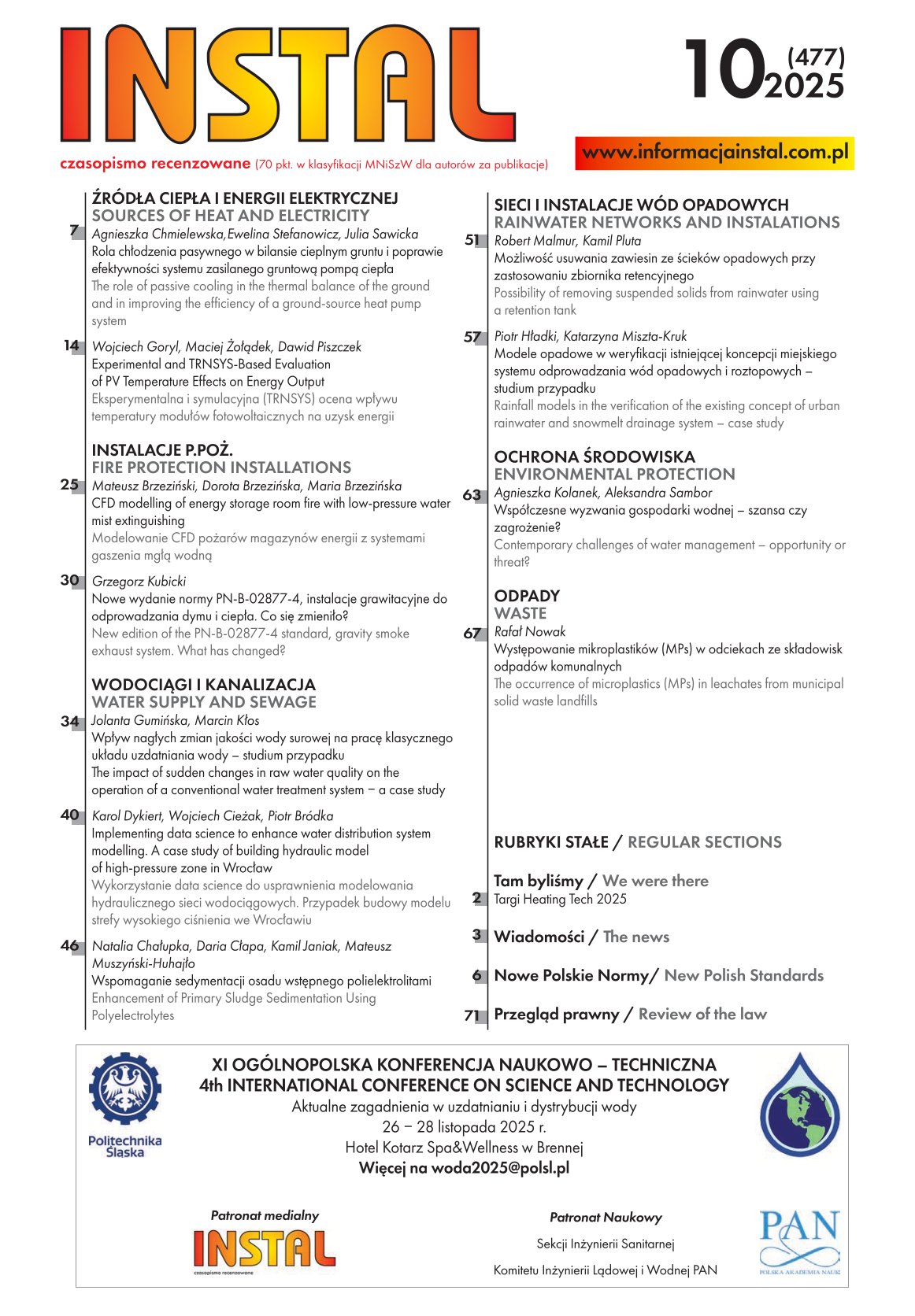
Implementing data science to enhance water distribution system modelling. A case study of building hydraulic model of high-pressure zone in Wrocław
DOI:
https://doi.org/10.36119/15.2025.10.6Keywords:
water distribution system modelling, data science, water distribution network, evolutionary algorithm, heuristic approach, artificial intelligenceAbstract
This study presents the development and calibration of a hydraulic model for a high-pressure zone (HPZ) within the water distribution network (WDN) of Wrocław. The work focuses on advanced data processing methods and calibration techniques to improve model accuracy, drawing upon established concepts from both environmental engineering and data science. Our results indicate a very good model fit, although with minor inconsistencies regarding pipe roughness calibration. The overall approach demonstrates how the integration of statistical, hydraulic, and optimisation techniques can lead to robust and reliable WDN modelling, supporting both academic and operational needs.
Downloads
References
Bylka J, Bałut A, Brodziak R, Zakrzewski P. Nodal Demand Control Genetic Algorithm for Water Supply Systems. Instal. 2022;10. doi:10.36119/15.2022.10.8
Cichoń T, Królikowska J. The role and importance of smart water meters in the water supply system [in Polish]. Rola i znaczenie inteligentnych wodomierzy w systemie zaopatrzenia w wodę. Instal. 2024;12.
doi:10.36119/15.2024.12.7
Di Nardo A, Boccelli DL, Herrera M, et al. Smart Urban Water Networks: Solutions, Trends and challenges. Water. 2021;13(4):501. doi:10.3390/w13040501
Published
License

This work is licensed under a Creative Commons Attribution 4.0 International License.
Authors retain copyright and grant the journal the right of first publication, with the work simultaneously licensed under a Creative Commons Attribution 4.0 International License, which permits others to share the work with appropriate acknowledgment of the authorship and initial publication in this journal.