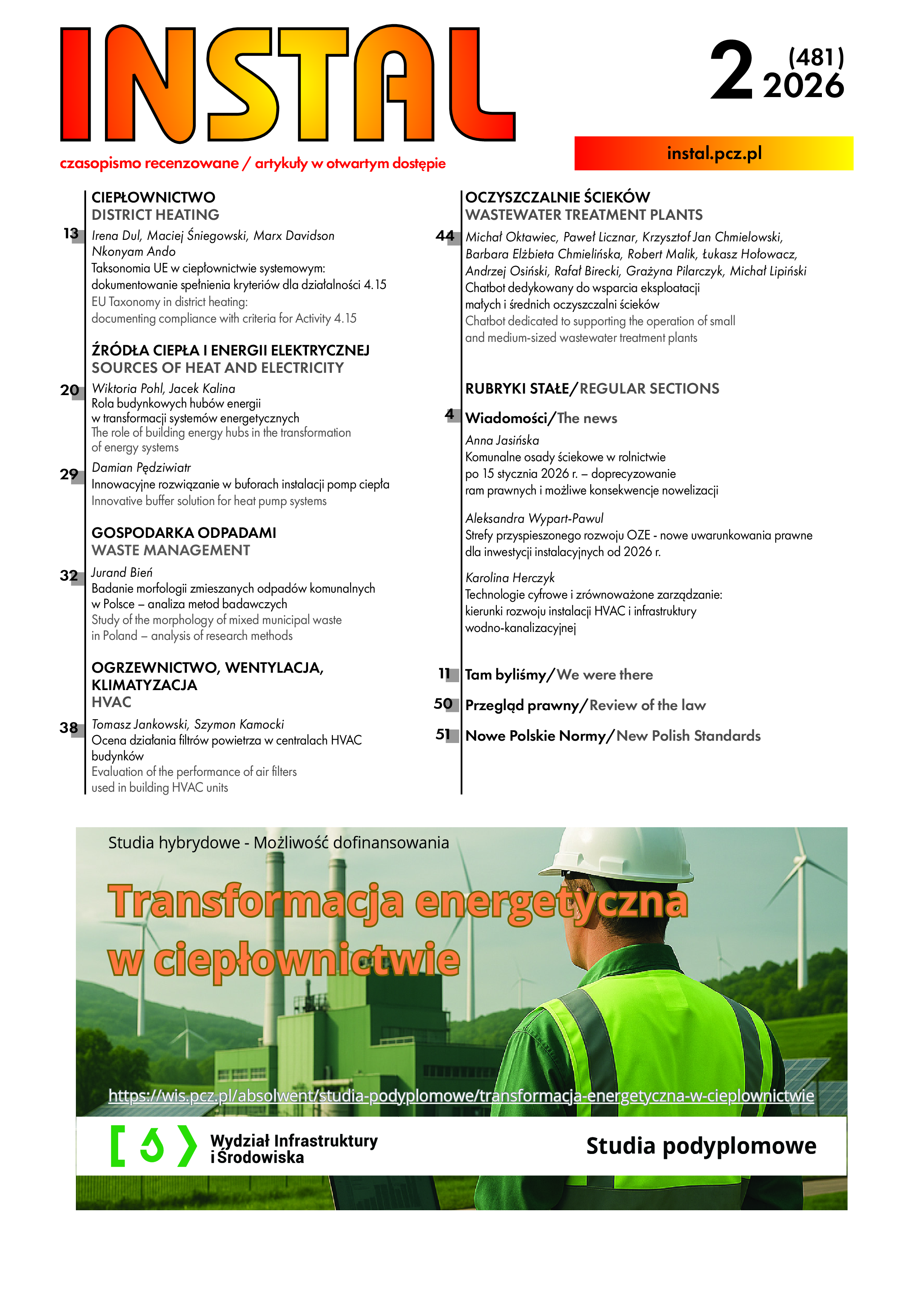
Study of the morphology of mixed municipal waste in Poland – analysis of research methods
DOI:
https://doi.org/10.17512/INSTAL.2026.02.04Keywords:
mixed municipal waste, sampling, morphological analysis of mixed waste, circular economyAbstract
The article presents a critical review and comparative analysis of mixed municipal waste morphology testing methodologies used in Poland, in light of the growing demands of climate policy and the circular economy. The starting point is the observation that, despite the increase in selective waste collection, the residual waste stream remains a significant decision-making challenge for municipalities and installations, and the lack of a uniform national standard limits the direct comparability of results between research campaigns. The paper summarizes and discusses four main approaches: the withdrawn PN-93/Z-15006 standard, the Jędrczak and Szpadt procedure (2006), the Atmoterm guidelines (2018), and the IOŚ-PIB (2021) framework. The analysis indicates that the discrepancies in results are primarily due to differences in sample mass and generation (including reduction), sieve configuration, treatment of the <10 mm fine fraction, and the degree of aggregation of the material fraction catalog. A unified approach was proposed by introducing a common methodological “core” (including controlled sample reduction, seasonality, transparent reporting of sieve fractions, and a consistent set of material fractions) and purpose-specific modules (e.g., a fuel or technology “on-line” module). This approach is intended to improve the quality of data for reporting, investment planning, and corrective actions in collection and recovery systems.
Downloads
References
[1] Mazur, M., Saluk, M., Jaźwiec, B., Frąk, B., den Boer, E., & den Boer, J. (2025). Optymalizacja odbioru odpadów komunalnych. Instal, (1), 53–55. DOI: 10.36119/15.2025.1.7
[2] European Commission. (2020). A new circular economy action plan: For a cleaner and more competitive Europe (COM(2020) 98 final). European Commission.
[3] Eurostat. (2025). Municipal waste statistics (data extracted January 2025). Statistics Explained.
[4] Kiprian, K., Łach, P., Nolepa, A., & Siemiątkowski, G. (2016). Metody oznaczania reprezentatywnego składu morfologicznego odpadów komunalnych. Prace Instytutu Ceramiki i Materiałów Budowlanych, 9(26), 61–71.
[5] Malinowski, M., & Woźniak, A. (2010). Wybrane metody oznaczania składu morfologicznego odpadów komunalnych w Polsce i wybranych krajach UE. Infrastruktura i Ekologia Terenów Wiejskich, (13), 29–39.
[6] Polski Komitet Normalizacyjny. (1993). Odpady komunalne stałe—Oznaczanie składu morfologicznego (PN-93/Z-15006). PKN.
[7] Jędrczak, A., & Szpadt, R. (2006). Określenie metodyki badań składu sitowego, morfologicznego i chemicznego odpadów komunalnych [Raport]. Kamieniec Wrocławski–Zielona Góra, Polska.
[8] Pietrzyk, J., Rackiewicz, I., Leoniewska-Gogola, J., & Pochwała, M. (2018). Wytyczne dla jednostek samorządu terytorialnego dotyczące realizacji badań w zakresie analizy składu morfologicznego odpadów komunalnych oraz wybranych właściwości fizycznych i chemicznych. Atmoterm S.A.
[9] Waszczyłko-Miłkowska, B., Kamińska-Borak, J., & Bernat, K. (2022). The real share of the morphological components of municipal waste generated in municipal systems in Poland. Environmental Protection and Natural Resources, 33, 13–18. https://doi.org/10.2478/oszn-2022-0007
[10] Instytut Ochrony Środowiska – Państwowy Instytut Badawczy. (2022). Morfologia odpadów komunalnych wytwarzanych w Polsce w systemie gminnym. IOŚ-PIB.
[11] ASTM International. (2003). Standard test method for determination of the composition of unprocessed municipal solid waste (ASTM D5231-92[2003]). ASTM International. https://doi.org/10.1520/D5231-92R03
[12] British Standards Institution. (2005). Characterization of waste—Sampling of waste materials—Framework for the preparation and application of a sampling plan (BS EN 14899:2005). BSI. https://doi.org/10.3403/30112012U
[13] Gy, P. (2012). Sampling of particulate materials: Theory and practice. Elsevier.. eBook ISBN: 9780444601353
[14] Rada Ministrów. (2023, 12 czerwca). Uchwała nr 96 Rady Ministrów w sprawie Krajowego planu gospodarki odpadami 2028 (M.P. 2023 poz. 702).
Downloads
Published
License

This work is licensed under a Creative Commons Attribution 4.0 International License.
Authors retain copyright and grant the journal the right of first publication, with the work simultaneously licensed under a Creative Commons Attribution 4.0 International License, which permits others to share the work with appropriate acknowledgment of the authorship and initial publication in this journal.