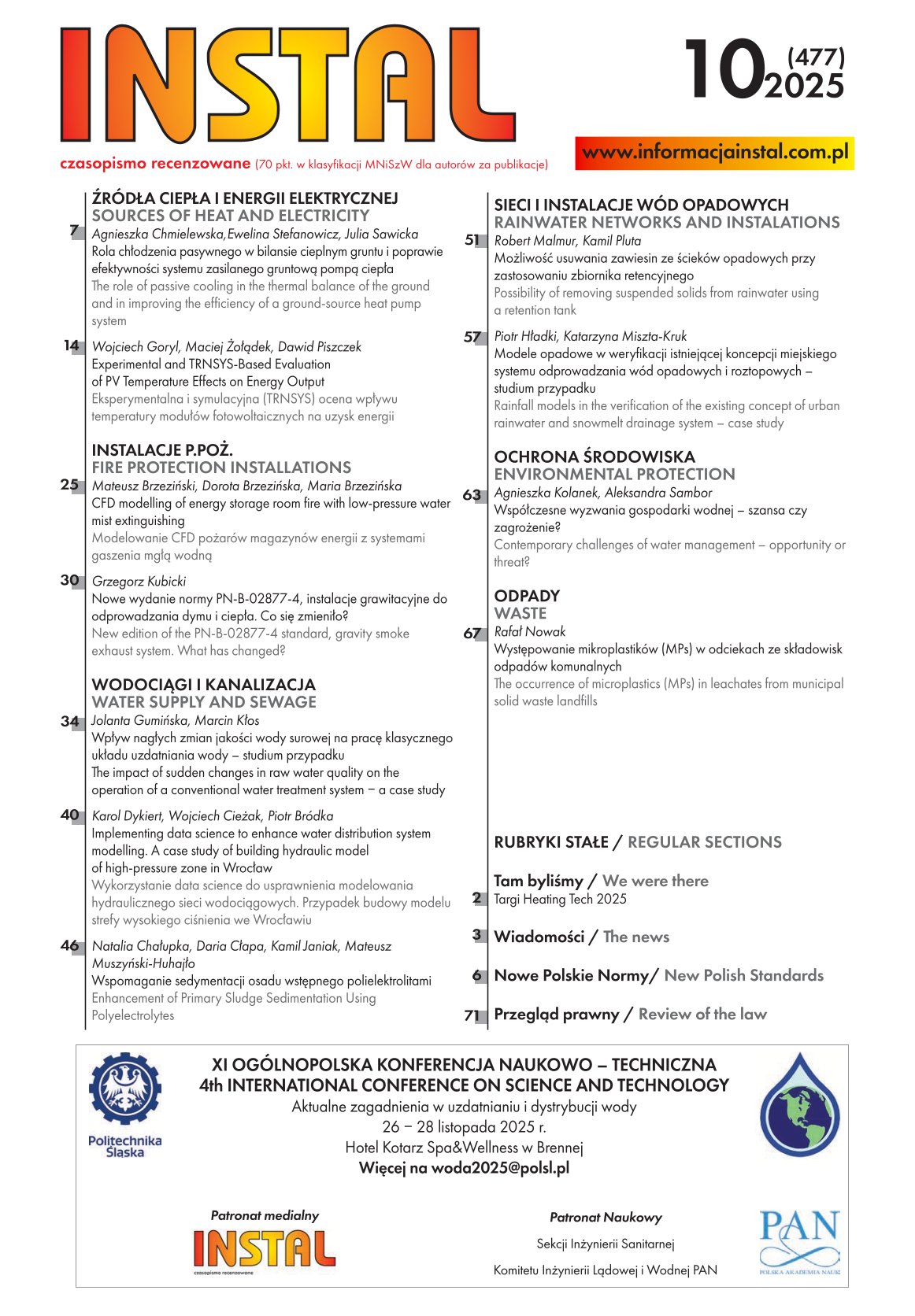
The impact of sudden changes in raw water quality on the operation of a conventional water treatment system ‒ a case study
DOI:
https://doi.org/10.36119/15.2025.10.5Keywords:
high variability in raw water quality, conventional coagulation, rapid filtrationAbstract
Under conditions of high variability in raw water quality, the analyzed technological system, operating on the basis of coagulation/flocculation, sedimentation, and rapid filtration processes in existing water treatment plant equipment, does not allow for stable operation of the technological system. This is most noticeable during periods when raw water turbidity increases from approximately 5 to a maximum of 114 NTU within a few hours. In the clarified water, a rapid increase in the turbidity of the water after the settling tank was also noted, up to 14.5 NTU, compared to the period preceding the sudden deterioration in the quality of the water feeding the system. The colour of the raw water varied between 12 and 180 gPt/m3. The clarified water showed a colour of 4 and 40 gPt/m3, resulting from the colour changes in the raw water. The colour of the filtered water varied between 1 and 13 Pt/m3. This is primarily due to the lack of optimal flocculation and sedimentation equipment, i.e., the low hydraulic efficiency of the settling tanks integrated with the vertical flocculation chambers. Therefore, in case of a sudden deterioration in raw water quality, the filters retained the excessive suspended solids that were not retained in the settling tanks. It was also shown that the permanganate index cannot be a reliable indicator for assessing the effectiveness of water treatment in the analyzed technological system.
Downloads
References
Akitt J., Farthing A.: Aluminium-27 NMR studies of the hydrolysis of aluminium (III). Journal of the Chemical Society, Dalton Transactions 1981, No. 7, pp. 1606-1626.
Allouche L., Taulelle F.: Conversion of Al13 Keggin ε into Al30: a reaction controlled by aluminum monomers. Inorganic Chemistry Communications 2003, Vol. 6, No. 9, pp. 1167-1170.
Bertsch P., Thomas G., Barnhisel R.: Characterization of hydroxyl-aluminum solutions by aluminum-27 nuclear magnetic resonance spectroscopy. Soil Science Society of America Journal 1986, Vol. 50, No. 3, pp. 825-834.
Downloads
Published
License

This work is licensed under a Creative Commons Attribution 4.0 International License.
Authors retain copyright and grant the journal the right of first publication, with the work simultaneously licensed under a Creative Commons Attribution 4.0 International License, which permits others to share the work with appropriate acknowledgment of the authorship and initial publication in this journal.