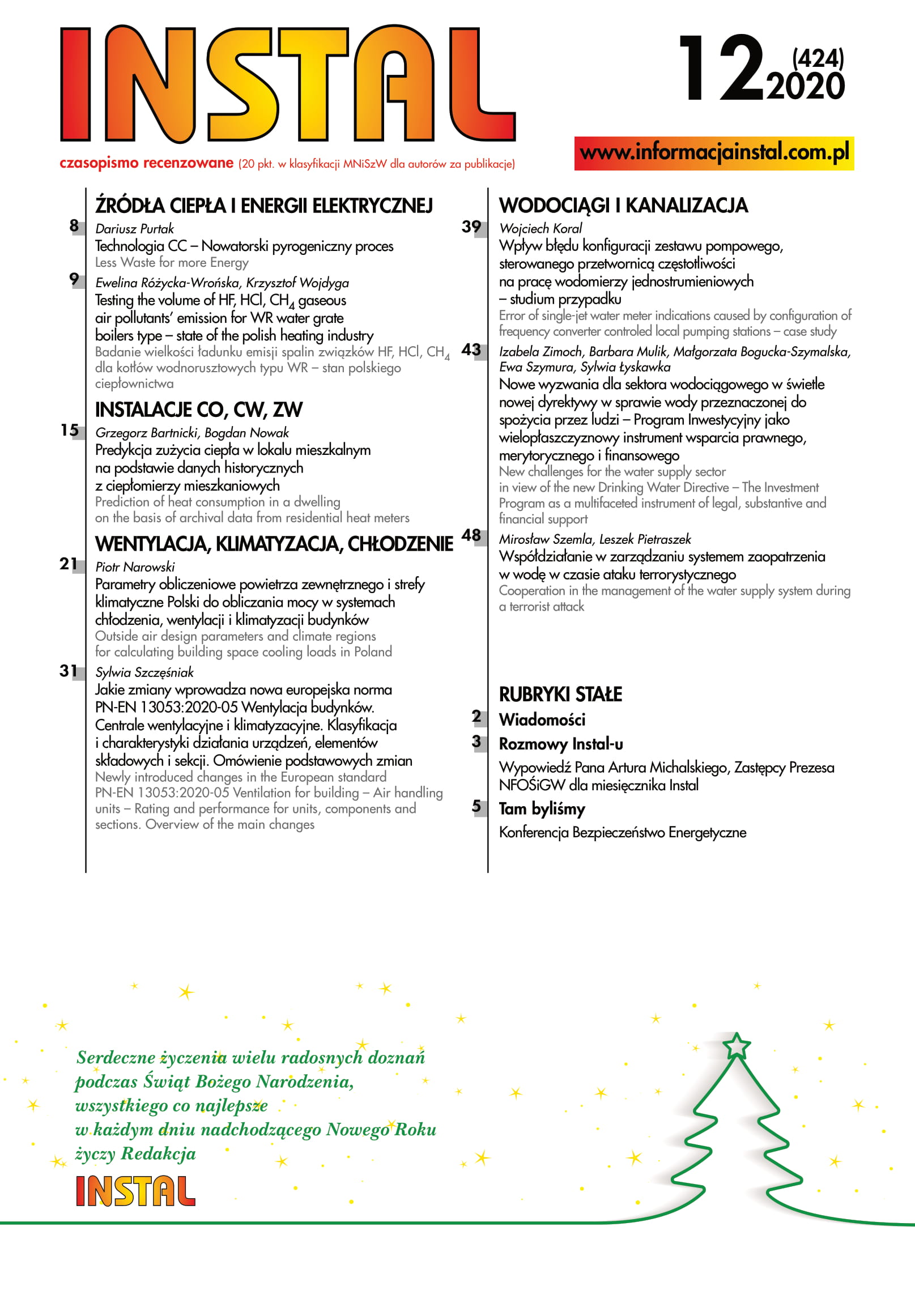
Cooperation in the management of the water supply system during a terrorist attack
DOI:
https://doi.org/10.36119/15.2020.12.7Keywords:
terrorism, water supply system, critical infrastructure, crisis managementAbstract
The article presents the conclusions from the excercise of rescue services, the police, the institutions responsible for sanitary security and companies responsible for providing water for the Silesia Region in Poland, inhabited by approximately 3.5 mln people. In October 2018, the simulation excercise code-named ‘Crisis 2018’ was carried out. It involved an incident of a terrorist attack aiming at infecting drinking water in the Municipal Water Works. The simulation excercise carried out on the basis of the proprietary script was meant to check the effectiveness of the procedures expected to be used in such situations. It was established that contamination of water by pouring hazardous substances directly into the main waterwork is a serious danger due to the difficulty in its detection, pace and its impact. The conclusions motivate to accept new recommendations and introduce modifications of the secure procedures for critical infrastructure. The monitoring system of an extensive critical infrastructure should be equipped with the remote notyfing system informing about a possible interference. The duty to notify the area owner/ administrator, the Sanitary Inspection and the City Council about the suspicion of water contamination in order to turn off the relevant parts of a pipeline should be introduced to the notifying instruction used on the command post. The conclusions drawn from the observation like this could also make the water company better prepared for possible terrorist attacks in the future.
Downloads
References
Benjamin, M. M.: Water Chemistry. 2nd Edition. Waveland Press, Inc., Long Grove (USA), 2015.
Boryczko, K..: Water age in the water supply network as health risk factor associated with collective water supply, ECOL CHEM ENG A, 23(1), 33-43, DOI 10.2428/ecea.2016.23(1)3, 2016.
Boryczko, K., Piegdoń, I., Eid, M.: Collective water supply systems risk analysis model by means of RENO software. Safety, Reliability and Risk Analysis: Beyond the Horizon
Steenbergen et al. [Eds.], Taylor & Francis Group, London 2014, 1987–1992
Downloads
Published
License

This work is licensed under a Creative Commons Attribution 4.0 International License.
Authors retain copyright and grant the journal the right of first publication, with the work simultaneously licensed under a Creative Commons Attribution 4.0 International License, which permits others to share the work with appropriate acknowledgment of the authorship and initial publication in this journal.