
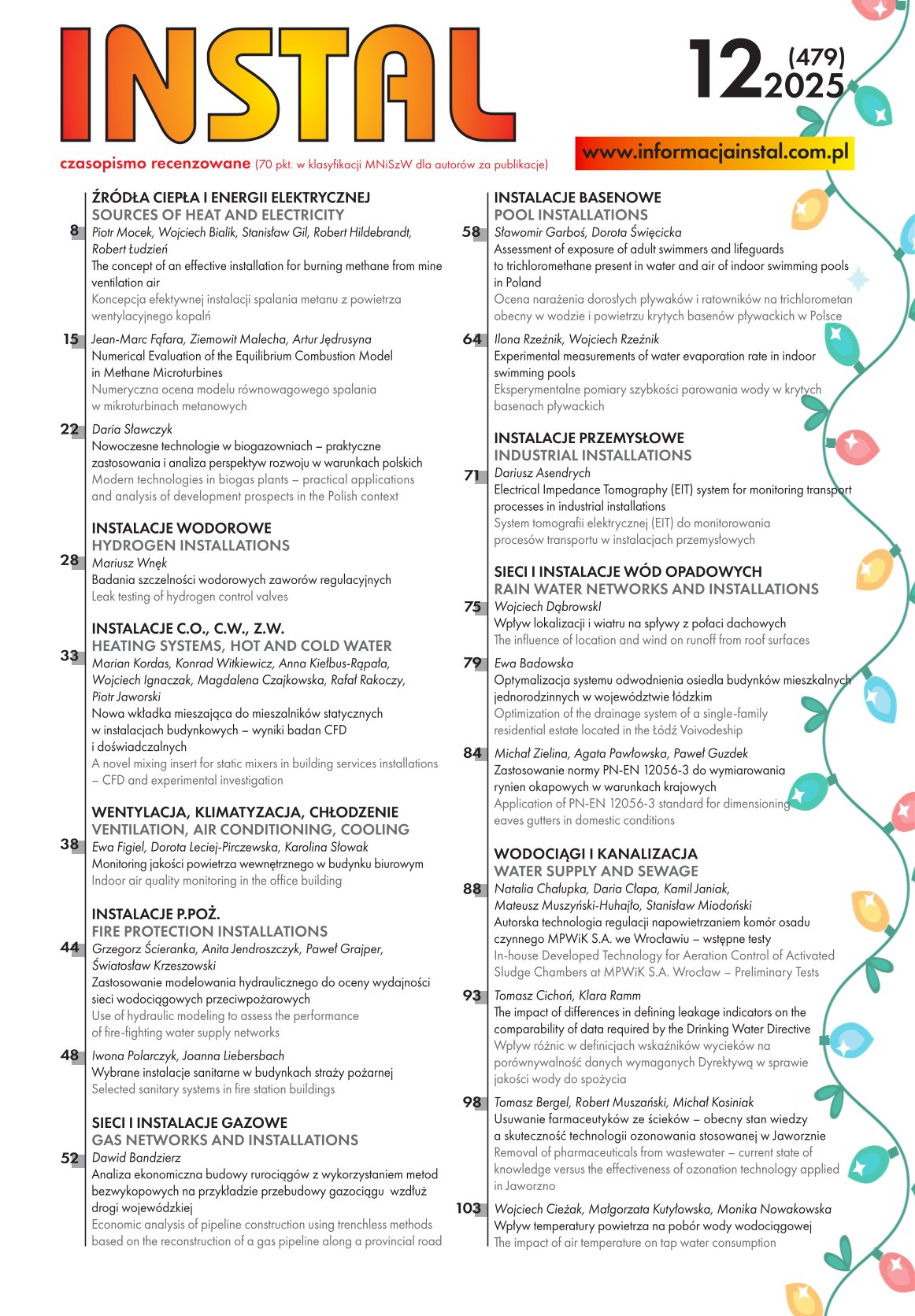
In-house Developed Technology for Aeration Control of Activated Sludge Chambers at MPWiK S.A. Wrocław – Preliminary Tests
DOI:
https://doi.org/10.36119/15.2025.12.21Keywords:
biological wastewater treatment, aeration, ammonium nitrogen, variable setpoint controlAbstract
Changes in the composition and load of wastewater entering treatment plants pose a challenge to maintaining stable operation of biological reactors. A particularly sensitive process is nitrification, whose efficiency depends on several factors, including oxygen availability and the concentration of ammonium nitrogen in the raw wastewater. Traditional control systems, based on fixed setpoints, often fail to respond adequately to fluctuations in nitrogen load, which can lead to reactor overloading or excessive energy consumption for aeration. A solution is the so-called variable-setpoint control, which enables automatic adjustment of aeration system parameters to the current demand. A key component of variable-setpoint control is on-line measurement of ammonium ion (NH4+) concentration and, optionally, the measurement of wastewater flow/nitrogen load at the reactor inlet and outlet. In this control strategy, the oxygen concentration setpoint is not fixed over time but becomes a function of the current quality of biologically treated wastewater and, optionally, the biological reactor loading. The application of variable-setpoint control improves the stability of nitrogen removal processes while also reducing energy consumption and enhancing the quality of treated effluent. MPWiK S.A. in Wrocław is conducting tests of a proprietary aeration control system based on ammonium nitrogen monitoring, and this article presents the results of preliminary trials of the technology. At present, this approach enables savings of up to 14% compared to a reference treatment line operating with constant oxygen concentration control. Current challenges include the algorithm’s performance under very low nitrogen load conditions and maintaining an appropriate concentration of total nitrogen in the biologically treated effluent.
Downloads
References
Amand L., Olsson G., & Carlsson B. (2013). Aeration control – a review. Water science and technology: a journal of the International Association on Water Pollution Research, 67 11, 2374-98. https://doi.org/10.2166/wst.2013.139.
Copp, J. B. (2002). The COST Simulation Benchmark: Description and Simulator Manual.
Drewnowski, J., Remiszewska-Skwarek, A., Duda, S., & Łagód, G. (2019). Aeration Process in Bioreactors as the Main Energy Consumer in a Wastewater Treatment Plant. Review of Solutions and Methods of Process Optimization. Processes. https://doi.org/10.3390/pr7050311
Downloads
Published
License

This work is licensed under a Creative Commons Attribution 4.0 International License.
Authors retain copyright and grant the journal the right of first publication, with the work simultaneously licensed under a Creative Commons Attribution 4.0 International License, which permits others to share the work with appropriate acknowledgment of the authorship and initial publication in this journal.