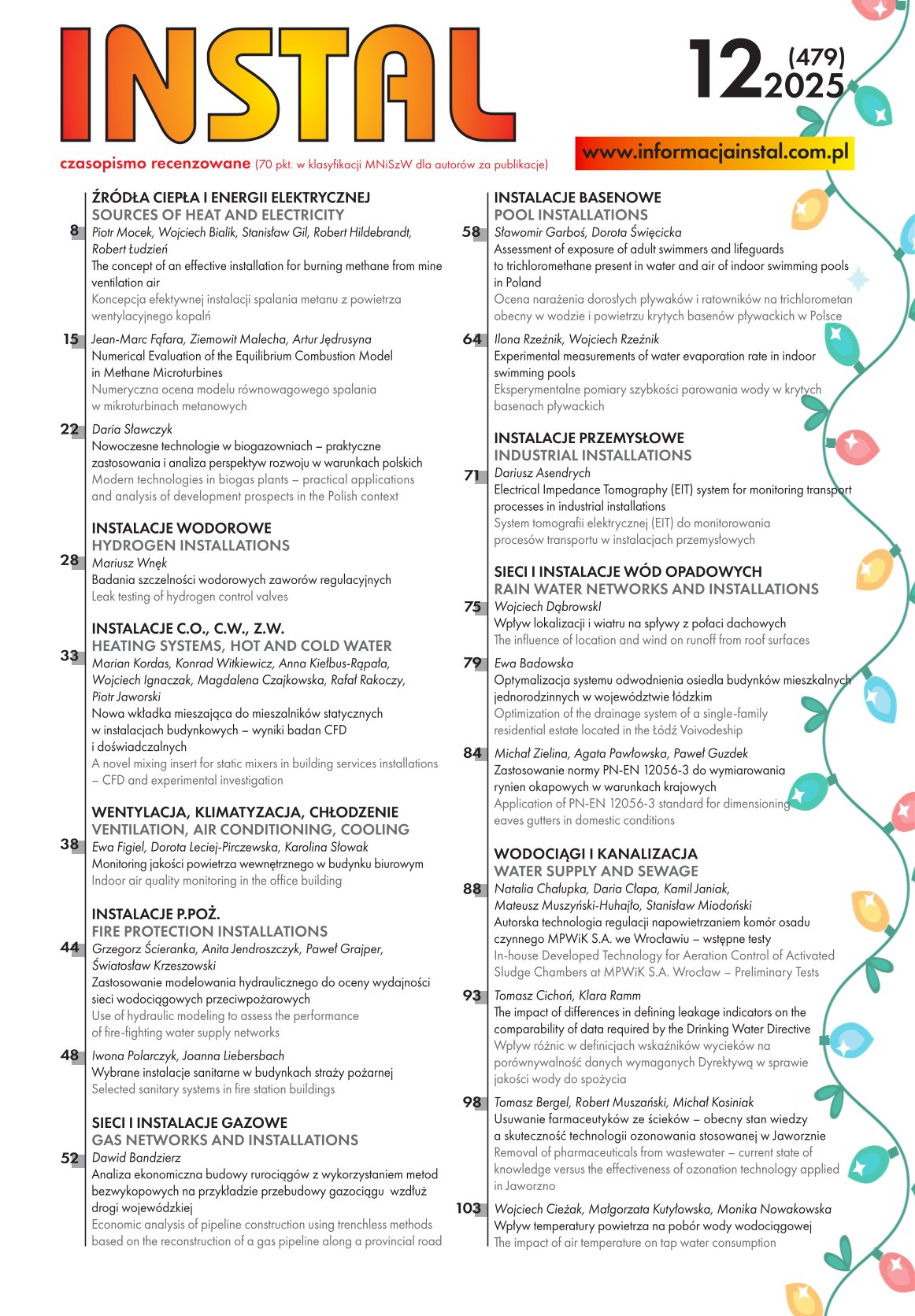
The impact of air temperature on tap water consumption
DOI:
https://doi.org/10.36119/15.2025.12.18Keywords:
lower air temperatures, water distribution histograms, season, correlationAbstract
This article analyzes the impact of a sudden drop in air temperature associated with the passage of the Genoese low in September 2024 on the water consumption pattern in a small distribution system located near Wrocław. The aim of the study was to investigate changes in the hourly distribution of water consumption caused by a sudden thermal anomaly. The study was conducted using 30 days of operational data (August 22-September 20, 2024), comparing daily and hourly water consumption with the maximum daily temperature. A significant, positive linear correlation (R=0.76) was found between maximum air temperature and water consumption for daily values, confirming that warmer days imply higher consumption, while sudden cooling leads to a reduction. The highest daily consumption (465.71 m³/d) was recorded during the heatwave, while after a sudden weather breakdown in mid-September, consumption dropped to only 56% of the maximum value. In turn, the analysis of hourly water consumption showed that this relationship is nonlinear. Therefore, an exponential function was proposed to describe the relationship between hourly consumption and temperature, considering linear regression to be inadequate. The results highlight the need to update water consumption forecasting models to account for the dynamic impact of rapid meteorological fluctuations.
Downloads
References
Alikhani MR, Moeini R. Predicting the urban water demand by equipping intelligent-based methods with discrete wavelet transform function. Appl Water Sci. 2025;15(2). doi:10.1007/s13201-025-02368-7.
Bakker M, Van Duist H, Van Schagen K, Vreeburg J, Rietveld L. Improving the performance of water demand forecasting models by using weather input. Procedia Engineering. Vol 70. 2014;93-102. doi: 10.1016/j.pro-eng.2014.02.012.
Cieżak W, Cieżak J. Routine forecasting of the daily profiles of hourly water distribution in cities. An effectiveness analysis. Environment Protection Engineering. 2015;41(2). doi: 10.5277/epe150215.
Downloads
Published
License

This work is licensed under a Creative Commons Attribution 4.0 International License.
Authors retain copyright and grant the journal the right of first publication, with the work simultaneously licensed under a Creative Commons Attribution 4.0 International License, which permits others to share the work with appropriate acknowledgment of the authorship and initial publication in this journal.