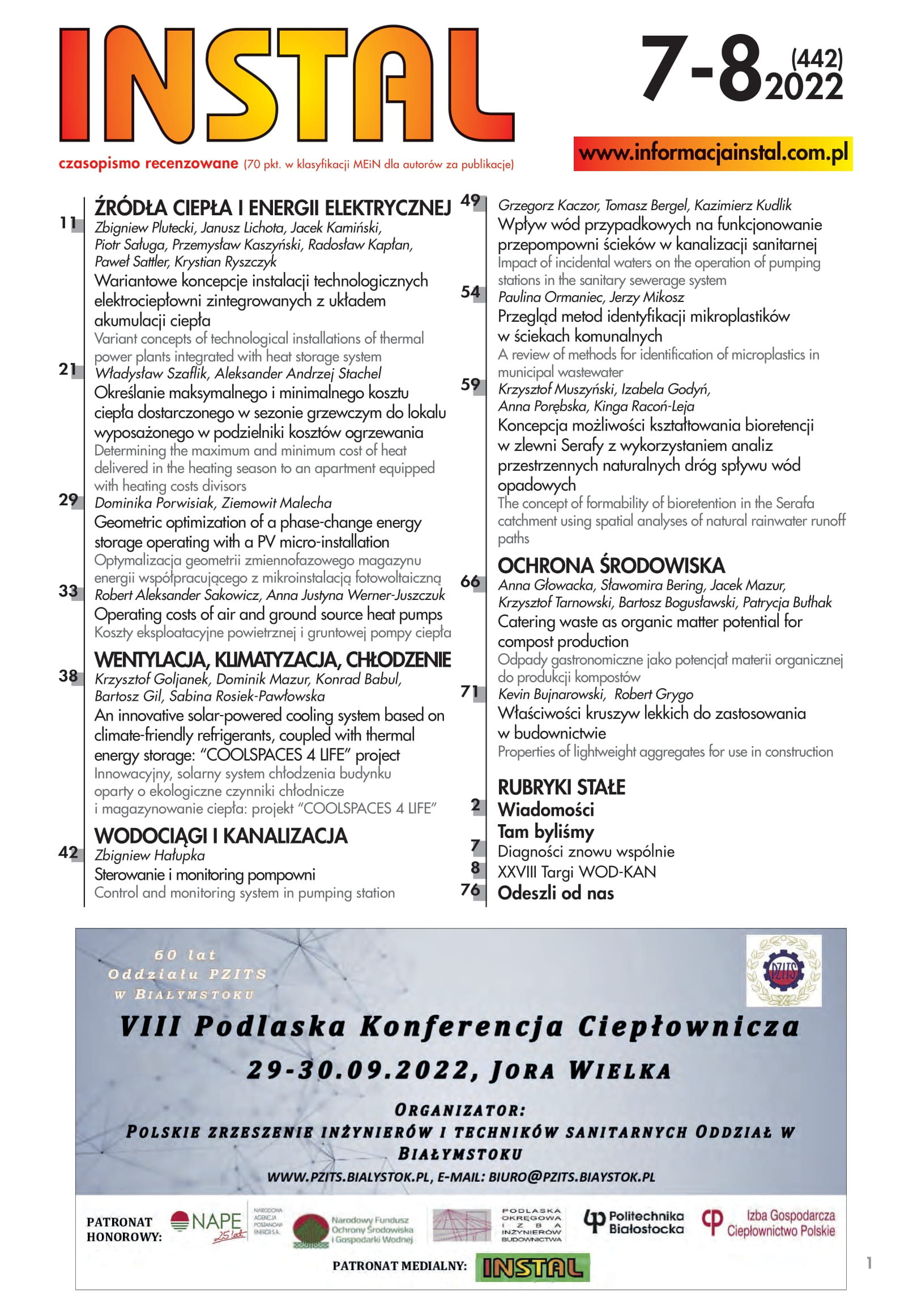
A review of methods for identification of microplastics in municipal wastewater
DOI:
https://doi.org/10.36119/15.2022.7-8.7Keywords:
microplastic, wastewater treatment plant, municipal wastewater, sewage sludgeAbstract
Pollution of the environment with plastic waste is currently one of the leading global environmental problems. A huge concern, not yet legally regulated, is the presence of microplastic in municipal wastewater treatment plants. Microplastic is plastic particles that do not exceed 5 mm in size. The article discusses generally available identification methods of microplastic isolated from wastewater treatment plants samples, taking into account the division into chemical and physical methods. The characteristics of the presented methods have been developed based on a review of literature sources. A physical analysis involves the evaluation of size and number or other physical properties such as color and shape. For this purpose, microscopes are used, in particular optical microscopes. In addition, a melt test and a hot needle test are performed to confirm that the observed particles are made of plastic. Chemical analysis of microplastics is based on the determination of polymer composition. Among the commonly used analyzes, the most popular is Fourier Transform Infrared (FTIR) spectroscopy, which uses three optimization methods: Attenuated Total Reflectance (ATR), Focal Plane Array (FPA) and micro-FTIR. This work focuses on a review of current research on the identification and characterization of microplastics in wastewater treatment plants. Although the research focused on microplastics to date has undoubtedly raised the level of understanding of the topic, but it is clear that many questions remain unanswered and thus the standardization of methods for identifying microplastics becomes crucial.
Downloads
References
PlasticEurope (2020). Plastics – the Facts 2020. An analysis of European plastics production, demand and waste data, strona internetowa: https://plasticseurope.org/knowledge-hub/plastics-the-facts-2020/dostęp w dn. 13.05.2022
GESAMP (2015). Sources, fate and effects of microplastics in the marine environment: a global assessment (IMO/FAO/UNESCO IOC/UNIDO/WMO/IAEA/UN/ UNEP/ UNDP Wspólna grupa ekspertów pracująca
nad naukowymi aspektami ochrony środowiska morskiego (Kershaw, P. J., ed.), strona internetowa: http://www.gesamp.org/publications/reports-and-studies-no-90, dostęp w dn. 10.05.2020
Directive (EU) 2020/2184 of the European Parliament and of the council of 16 December 2020 on the quality of water intended for human consumption
Downloads
Published
License

This work is licensed under a Creative Commons Attribution 4.0 International License.
Authors retain copyright and grant the journal the right of first publication, with the work simultaneously licensed under a Creative Commons Attribution 4.0 International License, which permits others to share the work with appropriate acknowledgment of the authorship and initial publication in this journal.