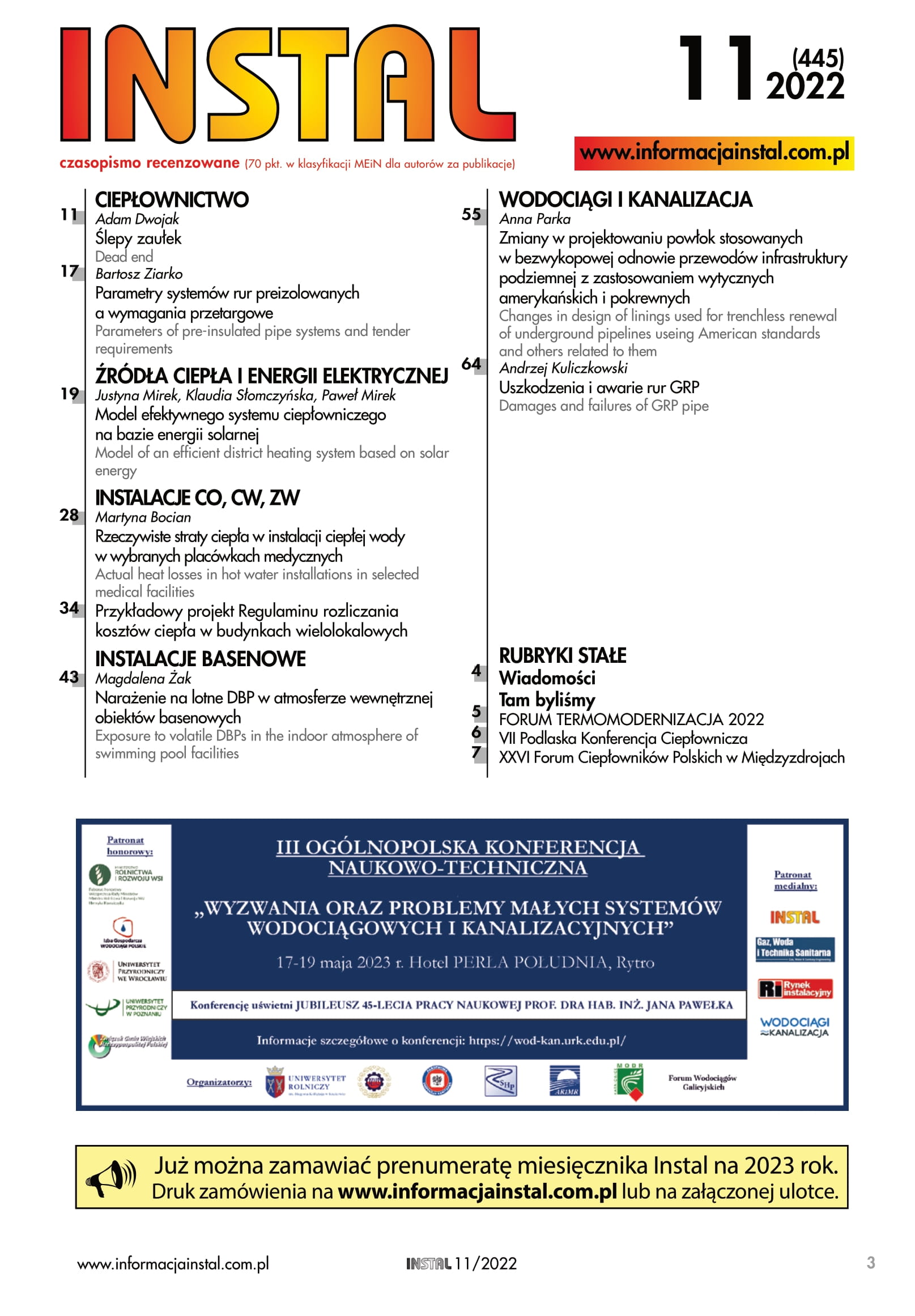
Model of an efficient district heating system based on solar energy
DOI:
https://doi.org/10.36119/15.2022.11.1Keywords:
efficient district heating system, TRNSYS, hydrogen, solar energy, PTES thermal energy storageAbstract
Moving away from burning coal-based fuels, increasing the use of renewable energy sources, and consequently achieving efficient district heating system status - these are the main priorities and challenges for system heat production in Poland. One way for a district heating system to achieve efficient status is to increase the share of weather-dependent renewable energy sources. The use of such sources additionally improves energy security through independence from external fuel supplies, and stabilizes heat prices. The paper presents a concept of a solar thermal system, based on large-scale solar farms combined with seasonal heat storage, and photovoltaic farms, in which renewable energy sources accounted for more than 93% of the total energy input into the system. In addition, two variants of the system were compared - differing in the use of a hydrogen electrolysis plant, and a cogeneration unit using hydrogen engines. Calculations were carried out under Polish weather conditions, using the TRNSYS 18 simulation software. It was shown that the use of a cogeneration engine raises the unit cost of heat by 16.75 PLN/GJ without a clear impact on increasing the share of RES in the energy production process, and energy efficiency. For the size of the plant under study, the system concept without the hydrogen path (LCOH = PLN 99.43/GJ) is more economically justified.
Downloads
References
Urząd Regulacji Energetyki, “Energetyka cieplna w liczbach – 2020,” URE, Warszawa, Luty 2022.
Wang D., Orehounig K., Carmeliet J., A Study of District Heating Systems with Solar Thermal Based Prosumers, Energy Procedia, 2018, 149, 132-140
Tian Z., Zhang S., Deng J., Fan J., Huang J., Weiqiang K., Perers B., Furbo S., Large-scale solar district heating plants in Danish smart thermal grid: Developments and recent trends, Energy Conversion and Management, 2019,189, 67-80
Downloads
Published
Issue
Section
Categories
License

This work is licensed under a Creative Commons Attribution 4.0 International License.
Authors retain copyright and grant the journal the right of first publication, with the work simultaneously licensed under a Creative Commons Attribution 4.0 International License, which permits others to share the work with appropriate acknowledgment of the authorship and initial publication in this journal.