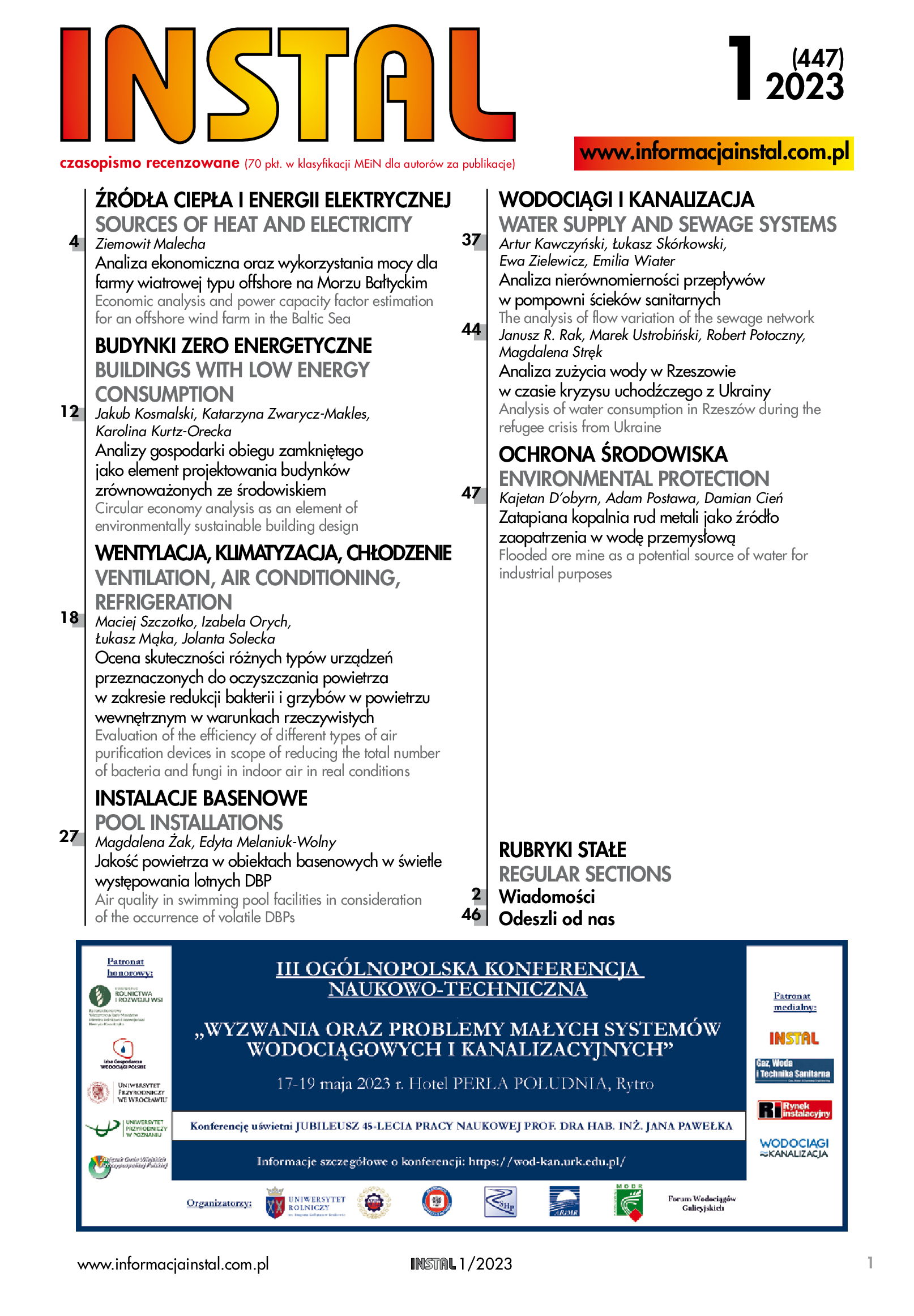
Circular economy analysis as an element of environmentally sustainable building design
DOI:
https://doi.org/10.36119/15.2023.1.2Keywords:
circular economy, nZEB standard, low-emission construction, sustainable construction, environmentally friendly buildingsAbstract
The article presents a conceptual design of a single-family dwelling building that meets the current near-zero energy standard (nZEB), in which the principles of circular economy, including architectural design, selection of construction, materials and installation solutions, were taken into account in the design phase.
Downloads
References
Sadi M.A.K., Abdullah A., Sajoudi M.N., Mustaffa Kamal M.F.B., Torshizi F., Taherkhani R., Reduce, Reuse, Recycle and recovery in Sustainable Construction Waste Management. Advanced Materials Research, Vol. 446-449/2012, pp 937-944.
Being wise with waste: the EU’s approach to waste management. European Commission, Directorate-General Environment, Information Centre (BU-9 0/11). Publication Office of the European Union, Luxemburg. 2010.
Arslan H., Coşgun N., Salgın B., Construction and Demolition Waste Management in Turkey – An Integrated Vision. IntechOpen, 2012, DOI: 10.5772/46110
Downloads
Published
License

This work is licensed under a Creative Commons Attribution 4.0 International License.
Authors retain copyright and grant the journal the right of first publication, with the work simultaneously licensed under a Creative Commons Attribution 4.0 International License, which permits others to share the work with appropriate acknowledgment of the authorship and initial publication in this journal.