
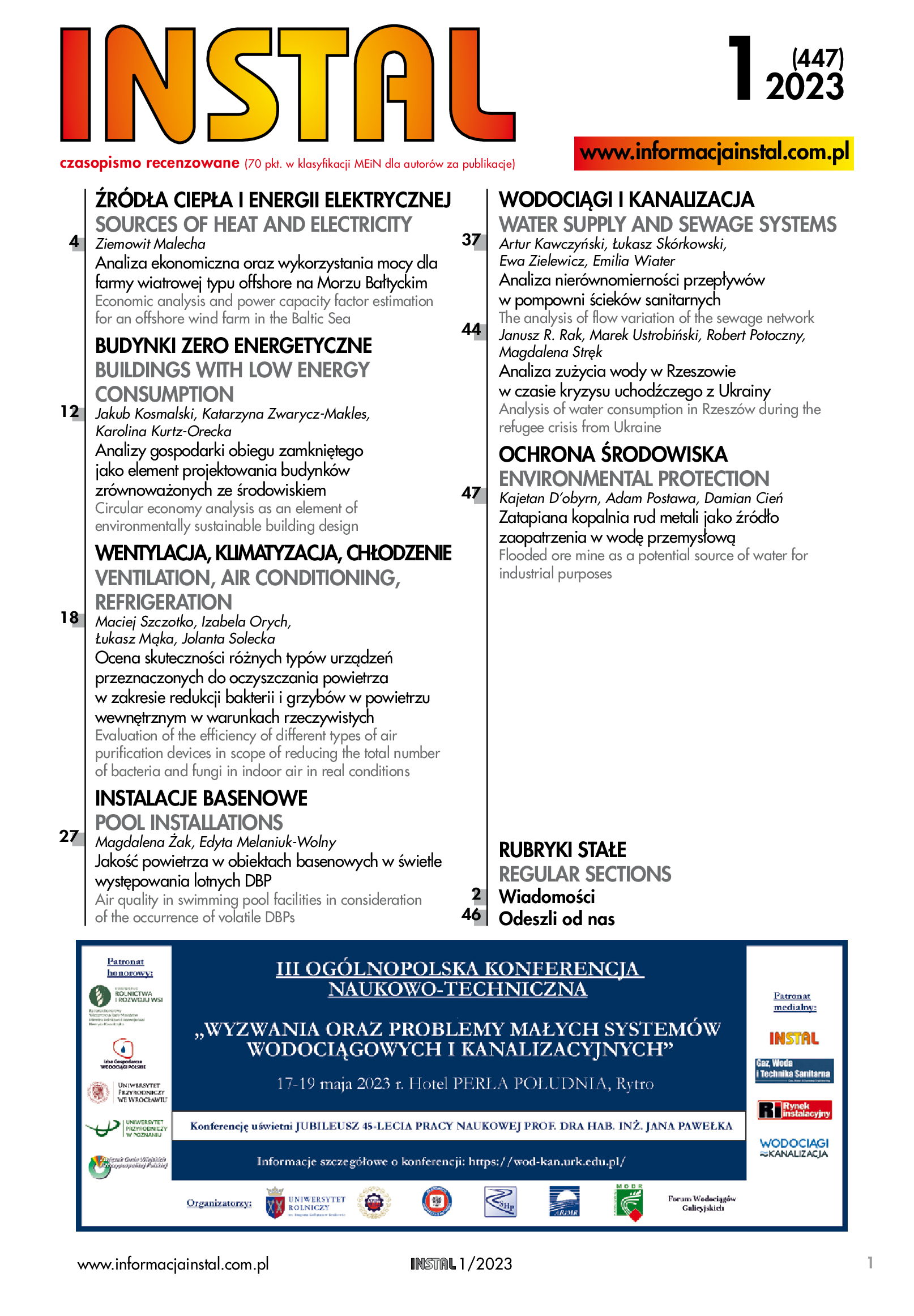
Economic analysis and power capacity factor estimation for an offshore wind farm in the Baltic Sea
DOI:
https://doi.org/10.36119/15.2023.1.1Keywords:
wind farm, power utilization, losses, Jensen model, square-cube laAbstract
The paper analyzes the possibilities of power production for offshore wind farms for the planned location in the Baltic Sea. In addition, a simplified economic analysis of such an investment was carried out. Real data of existing onshore and offshore installations, analyzes performed by renowned research centers such as the National Renewable Energy Laboratory (NREL) from the USA, or the Jensen model to estimate wind farm losses were used. It has been shown that the capacity factor for a wind farm in the Baltic Sea is about 46%, while wind farm losses can range from 12% to 18% depending on the size of the turbines. The conducted economic analysis showed that the return on investment costs strongly depends on the rated power of wind turbines and can range from several to dozen years.
Downloads
References
Lissaman, P.B.S.; Gyatt, G.W.; Zalay, A. Critical issues in the design and assessment of wind turbine arrays, 1982.
Gawronska, G.; Gawronski, K.; Król, K.; Gajecka, K. Wind farms in Poland – legal and location conditions. The case of Margonin wind farm. GLL Geomatics 2019, 3, 25–39. http://dx.doi.org/10.15576/GLL/2019.3.25.
DTI. Capital grants scheme for Scroby Sands offshore wind farm. Technical report, UK Government, 2006.
DTI. Capital grants scheme for North Hoyle offshore wind farm. Technical report, UK Government, 2006
Downloads
Published
License

This work is licensed under a Creative Commons Attribution 4.0 International License.
Authors retain copyright and grant the journal the right of first publication, with the work simultaneously licensed under a Creative Commons Attribution 4.0 International License, which permits others to share the work with appropriate acknowledgment of the authorship and initial publication in this journal.