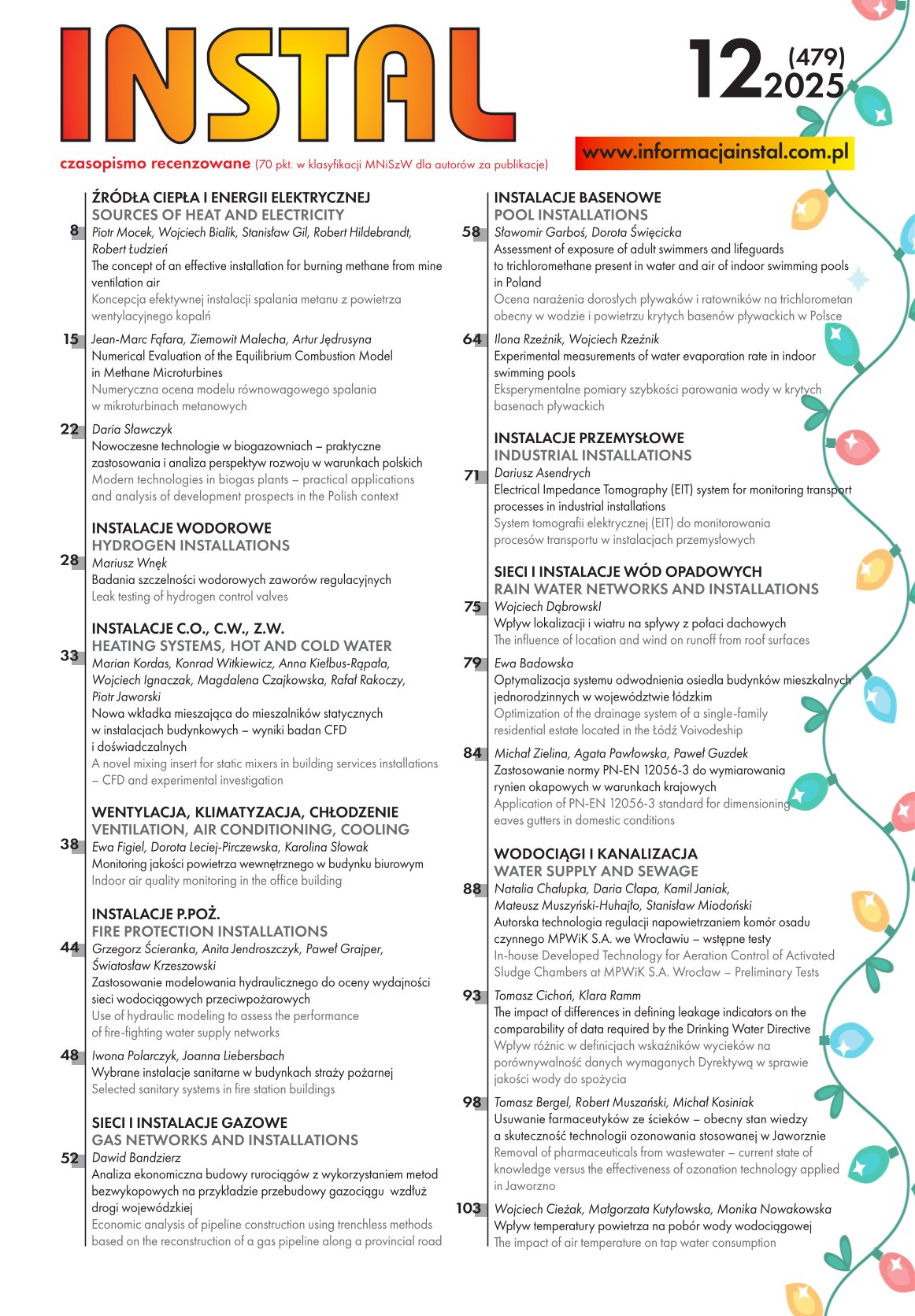
Assessment of exposure of adult swimmers and lifeguards to trichloromethane present in water and air of indoor swimming pools in Poland
DOI:
https://doi.org/10.36119/15.2025.12.10Keywords:
trichloromethane, indoor sports pools, swimming pool water, indoor air, adult swimmers, lifeguards, exposureAbstract
Concentrations of trichloromethane (TClM) in swimming pool water (SPW) and in air were determined in a total of thirteen indoor swimming pool facilities located in Poland. Disinfection of swimming pool water with sodium hypochlorite and gaseous chlorine leads to the formation of trihalomethanes (THMs) in SPW, primarily TClM, whose concentrations can reach a maximum of 28.1 µg/L in sports pools. On the other hand, TClM concentrations in the air of halls of indoor swimming pool facilities can reach values up to 150 µg/m3. In the assessment of exposure of adult swimmers, the share of the daily inhalation dose of TClM is dominant, accounting from 88.2% to 98.3% of the chronic daily intake (CDI) of this chemical compound, taking into account all three exposure routes: accidental oral intake of SPW (0.22-1.5% CDI), dermal contact with SPW (1.5-10.3% CDI) and inhalation of TClM with the air. Nevertheless, taking into account the observed levels of TClM concentrations in SPW of sports swimming pools and in the air, it can be concluded that the exposure of adult swimmers is negligible (Hazard Quotients << 1). Taking into account the estimated exposure of lifeguards to TClM (mainly inhalation exposure) and the legally defined value of the maximum admissible concentration (8 mg/m3), it can be concluded that the observed concentrations of this compound in the air of swimming pool halls do not adversely affect the health of this professional group.
Downloads
References
Chowdhury S, Alhooshani K, Karanfil T. Disinfection byproducts in swimming pool: occurrences, implications and future needs. Water Res. 2014;53:68-109. doi: 10.1016/j.watres.2014.01.017
Bożym M, Kłosok-Bazan I, Wzorek M. Analyzing THM Concentrations in Selected Indoor Swimming Pool Waters in the Opole Region. Pol. J. Environ. Stud. 2018;27(3):1001-1008. doi: https://doi.org/10.15244/pjoes/ 75828
Żarczyński K, Garboś S, Święcicka D, Kaniowska-Klarzyńska E. Badanie zawartości trihalometanów w wodzie basenowej i wodociągowej metodą chromatografii gazowej z detekcją wychwytu elektronów (GC-ECD). Instal. 2006:7-8;51-53.
Published
License

This work is licensed under a Creative Commons Attribution 4.0 International License.
Authors retain copyright and grant the journal the right of first publication, with the work simultaneously licensed under a Creative Commons Attribution 4.0 International License, which permits others to share the work with appropriate acknowledgment of the authorship and initial publication in this journal.