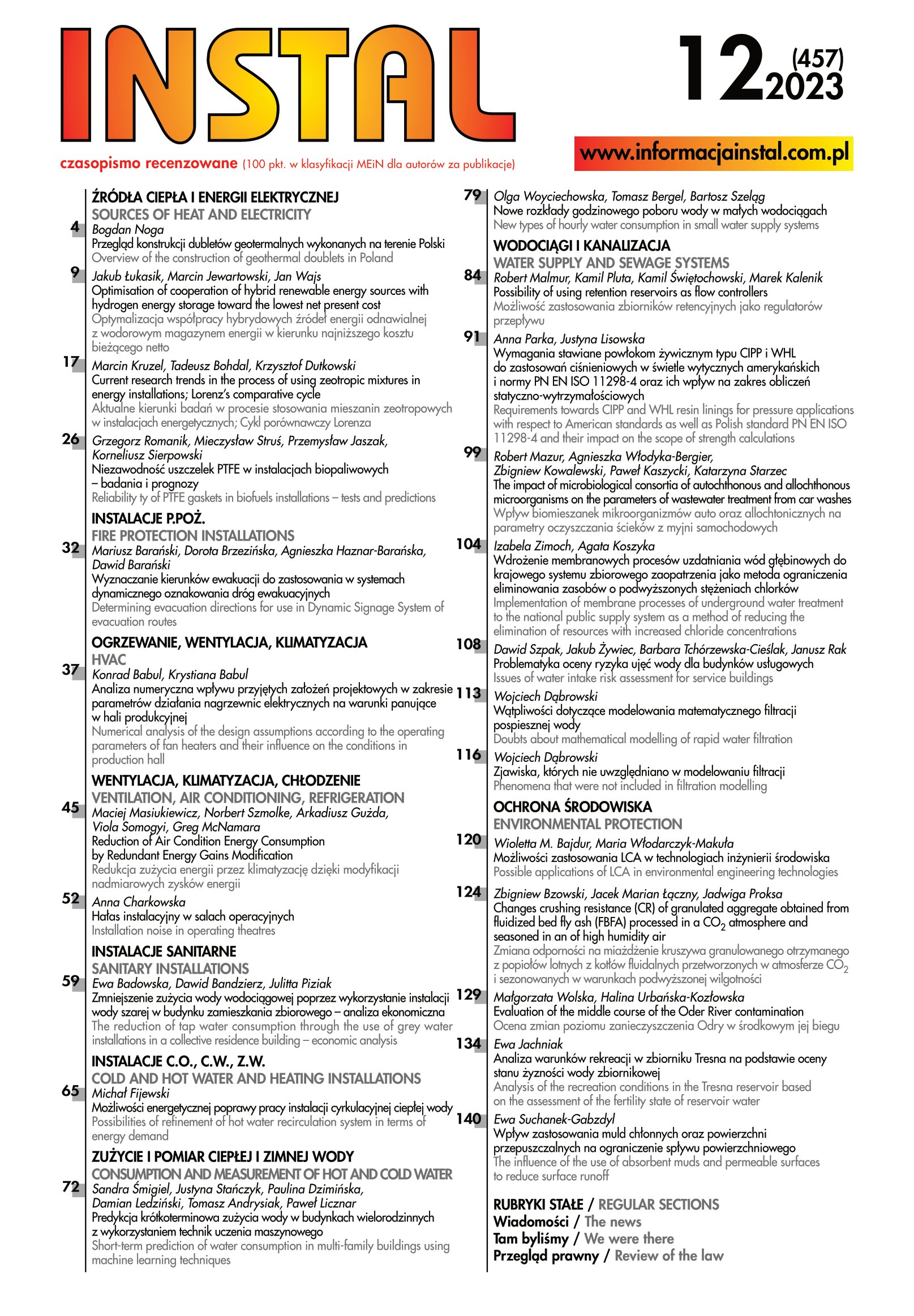
Changes crushing resistance (CR) of granulated aggregate obtained from fluidized bed fly ash (FBFA) processed in a CO2 atmosphere and seasoned in an of high humidity air
DOI:
https://doi.org/10.36119/15.2023.12.21Keywords:
fluidized bed fly ash, carbonated fluidized bed fly ash, granules, crushing resistance, mineralogical testsAbstract
The aim of the research presented in the article was to investigate how the high-humidity air environment changes the crushing resistance (CR) of granulated carbonated fluidized bed fly ash (CGFBFA). It was assumed that CR influences the way it is used in geoengineering as a substitute for natural aggregates. The results of testing the granulate obtained in the three-phase carbonation reaction with carbon dioxide and granulation process in a multifunctional rotary granulator (MRG) are presented. The obtained product was exposed for a period of time three years in the conditions of the atmosphere of the mine gallery of the experimental mine. The air humidity ranged from 76% to 98% and the temperature ranged from approx. 6°C to approx. 14°C. The crushing resistance tests (CRT) of the samples were carried out using a SCHIMADZU AGX-300kN VINSTON hydraulic press (USA).
Mineralogical studies were performed using the powder diffractometric method (DSH), using Bragg-Brentano geometry. The Bruker D8 Discover diffractometer, CuKa radiation, Ni filter and LYNXEYE_XE detector were used. Has been demonstrated, that the 3-year exposure of in the mine air atmosphere had a positive effect on the increase CR of CGFBFA, causing its increase from 5 MPa to 7.4 MPa, i.e. by approx. 32.4%. The increase of CR was interpreted as the result of the formation of relatively large amounts of gypsum in the composition in CGFBFA after the exposed period. Mineralogical research also leads to the preliminary conclusion that calcite and ettringite also play a role in this process. It was hypothesized that calcite is a binding factor at the stage of the carbonation
process. We assumed that later, this too phase participating in the crystallization process of ettringite by replacing some of the sulfate ions (SO32-) with CO32– ions. As a result of this process, the conditions of thermodynamic equilibrium in ettringite may change, which favours the crystallization of gypsum. This issue will be the subject of further research. Research carried out and analyses showed that granulation of LPF in an atmosphere of carbon dioxide may be a prospective method of their management in combination with CO2 utilization. This idea is consistent with the EU strategy regarding the circular economy (CE) and carbon dioxide sequestration and utilisation(CCS/CCSU).
Downloads
References
Łączny M.J., Bzowski Z.: Transformations of calcium sulphates in solidified carbonated volatile fluidized ashes. Journal of Sustainable Mining 16/4 (2017), 151-155.
Proksa J., Łączny M.J., Bzowski Z.: Evaluation of the possibility of using granulated carbonated volatile fly ash from fluidized bed (G-CVFA) in underground mining techniques. Archives of Mining Sciences 65/4 (2020), 737-750.
Blamey J., Anthony E.J., Wang J., Fennell P.S.: The calcium looping cycle for large-scale CO2 capture. Progress in Energy and Combustion Science 36 (2), (2010), 260-279
Downloads
Published
License

This work is licensed under a Creative Commons Attribution 4.0 International License.
Authors retain copyright and grant the journal the right of first publication, with the work simultaneously licensed under a Creative Commons Attribution 4.0 International License, which permits others to share the work with appropriate acknowledgment of the authorship and initial publication in this journal.