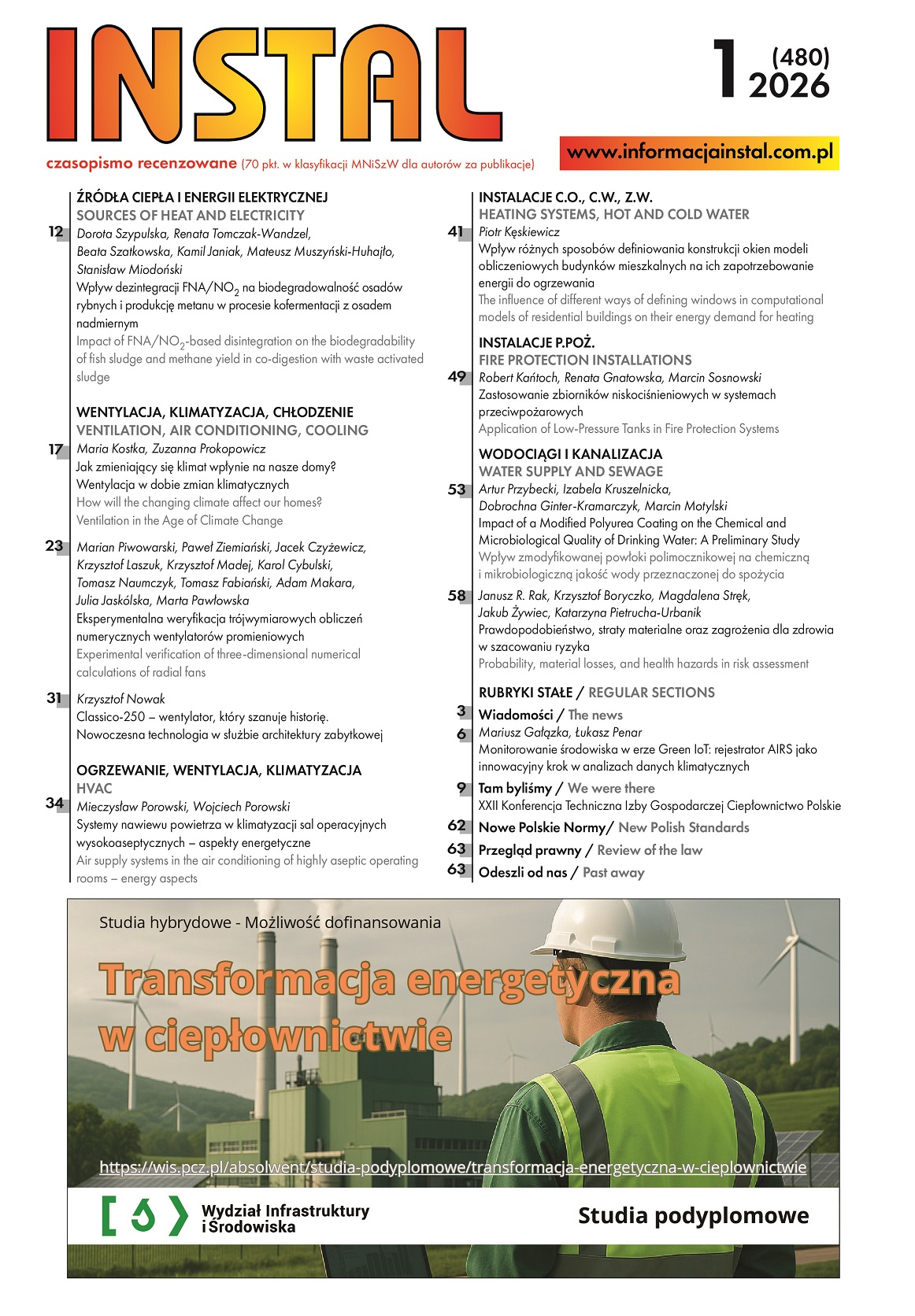
Impact of a Modified Polyurea Coating on the Chemical and Microbiological Quality of Drinking Water: A Preliminary Study
DOI:
https://doi.org/10.36119/15.2026.1.7Keywords:
spray-applied lining, polyurea composite, drinking water contact materials, substance migration, biofilm propensity, in-situ pipe rehabilitationAbstract
This study presents findings on the chemical and microbiological safety of the polyurea-based composite coating, designed for renovating potable water pipelines. Tests were performed in line with European standards PN-EN 12873-1, PN-EN 14395-1, and PN-EN 16421. The research examined metal, organic compound, and primary aromatic amine migration, along with organoleptic and microbiological water quality after contact with the coating. No regulatory limits were exceeded, and PAAs were below the detection threshold of 0.001 mg/L. These results demonstrate that
COVERLAN does not adversely impact drinking water quality and is safe for use in internal pipeline rehabilitation.
Downloads
References
[1] Whelton A.J., et al.: Impact of infrastructure coating materials on stormwater quality: review and experimental study. J. Environ. Eng., 2013, 139(5), s. 746–756; DOI: 10.1061/(ASCE) EE.1943-7870.0000665.
[2] Shojaei B., et al.: A review on the applications of polyurea in the construction industry. Polym. Adv. Technol., 2021, 32(8), s. 2797–2812; DOI: 10.1002/pat.5321.
[3] Barczewski M., et al.: Spray-formed polyurea composites filled with basalt powder as inorganic waste filler. Plast. Rubber Compos., 2021, 50(6), s. 276–284; DOI: 10.1080/14658011. 2021.1874882.
Downloads
Published
License

This work is licensed under a Creative Commons Attribution 4.0 International License.
Authors retain copyright and grant the journal the right of first publication, with the work simultaneously licensed under a Creative Commons Attribution 4.0 International License, which permits others to share the work with appropriate acknowledgment of the authorship and initial publication in this journal.