
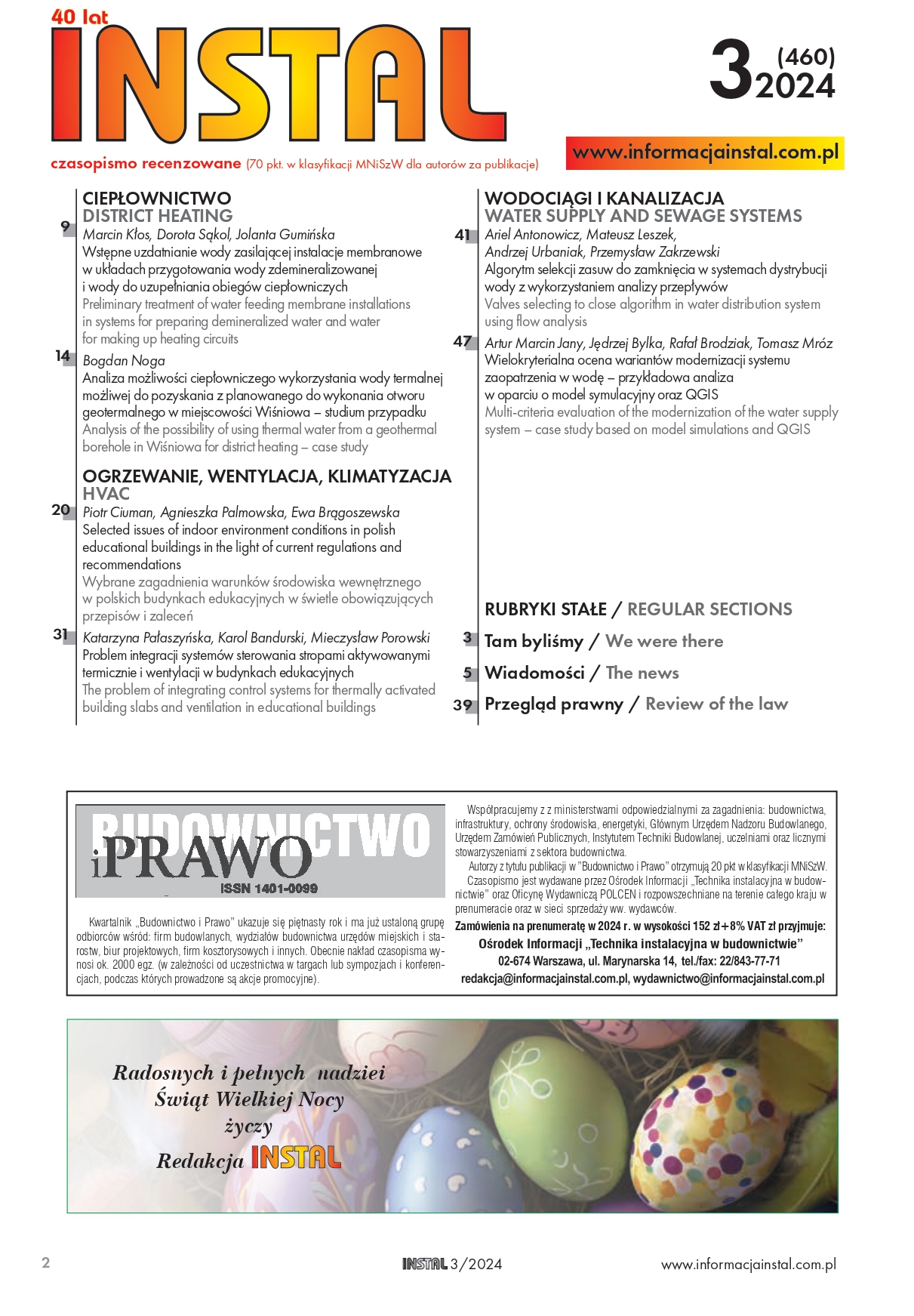
The problem of integrating control systems for thermally activated building slabs and ventilation in educational buildings
DOI:
https://doi.org/10.36119/15.2024.3.4Keywords:
TABS, TRNSYS, VAV, DCV, energy-efficient control, users, thermal comfortAbstract
building systems (TABS) in educational buildings, characterized by large and dynamically changing internal cooling loads, is presented. The problem of dissipating cooling loads through the TABS system in this kind of building was identified. The use of ventilation air to dissipate a portion of these loads was proposed, and simple control algorithms integrating the TABS system and the air system were compared. A simulation model of the system’s operation throughout the year was developed using the TRNSYS17 program as a research tool. The optimization problem of selecting energy-optimal control was solved, where the constraints were to meet thermal comfort conditions (operative temperature within the required range), and the objective function was to minimize the primary energy demand of the HVAC system throughout the year. TABS system control algorithms were based on: heating and cooling curves determined with the Unknown-But-Bounded (UBB) method and switching temperatures were determined with an original author’s method. Calculations were carried out for a case study – a lecture room in an educational building. It was demonstrated that only the integration of the TABS system with ventilation, also acting to dissipate part of the thermal loads TABS+VAV (Variable Air Volume), allows maintaining the operative temperature within the required comfort range for 83% of the occupation time for the most favorable comfort control variant. In the case where ventilation only served hygiene
purposes – TABS+DCV (Demand Control Ventilation), the time of operative temperature within the comfort range was only 14% of the room’s occupation time for the most favorable control variant.
Downloads
References
Asanati, K. et al. 2021. Healthier schools during the COVID-19 pandemic: ventilation, testing and vaccination. Journal of the Royal Society of Medicine. 114, 4 (Feb. 2021), 160–163. DOI : https://doi.org/10.1177/0141076821992449.
Burridge, H.C. et al. 2021. The ventilation of buildings and other mitigating measures for COVID-19: a focus on wintertime. Proceedings of the Royal Society A. 477, 2247 (Mar. 2021). DOI: https://doi.org/10.1098/RSPA.2020.0855.
Chung, W.J. and Lim, J.H. 2019. Cooling operation guidelines of thermally activated building system considering the condensation risk in hot and humid climate. Energy and Buildings. 193, (Jun. 2019), 226–239. DOI:https://doi.org/10.1016/j.enbuild.2019.03.049.
Downloads
Published
License

This work is licensed under a Creative Commons Attribution 4.0 International License.
Authors retain copyright and grant the journal the right of first publication, with the work simultaneously licensed under a Creative Commons Attribution 4.0 International License, which permits others to share the work with appropriate acknowledgment of the authorship and initial publication in this journal.