
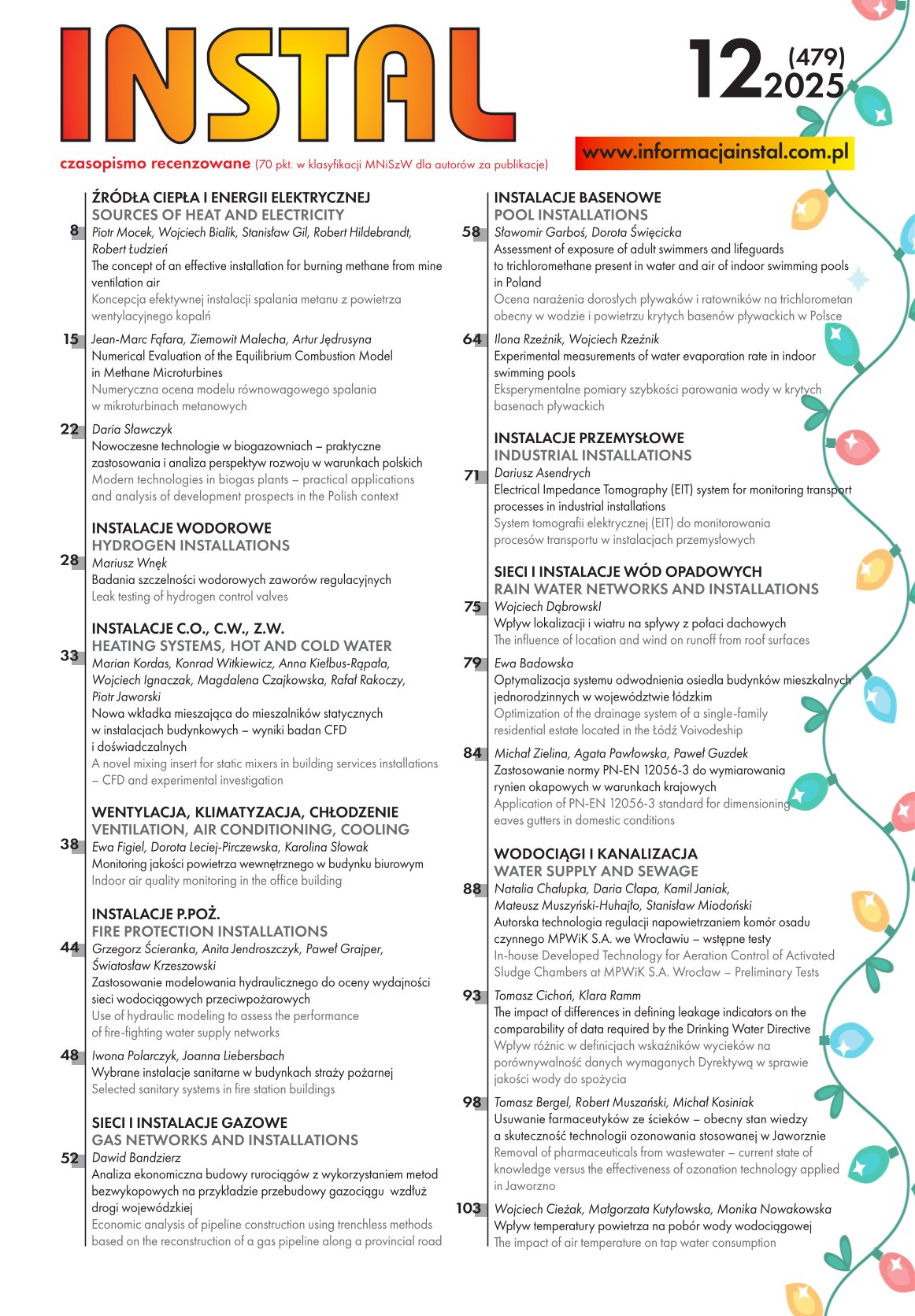
Indoor air quality monitoring in the office building
DOI:
https://doi.org/10.36119/15.2025.12.6Keywords:
indoor air quality, indoor air pollution, air quality monitoring, smart buildingAbstract
The aspect of indoor air quality has found special recognition in the current EU Directive on the energy performance of buildings (EPBD (2024/1275/EU), Article 13). It identifies a system for monitoring and regulating the parameters that contribute to indoor air quality as a key technical solution necessary to achieve and maintain adequate indoor air quality. It specifies that building automation and control systems must enable the monitoring of indoor environmental quality by 29 May 2026 at the latest. Air quality analysers based on radio technology enabling Internet connectivity (IoT) are a minimally invasive alternative to classic cable systems in this respect. Thanks to this functionality, they enable a significant reduction in the costs associated with equipping buildings with air quality monitoring and control systems. For this reason, meters with smart sensors based on IoT technology were deliberately used to measure air quality in a sample non-residential office and service building. The devices were selected based on an analysis of technical data provided by the manufacturer. The aim of this article is to further the particularly topical discussion on the role of indoor air quality monitoring in promoting a healthy, energy-efficient and productive
indoor environment by presenting an example of good practice in this area. It reviews scientific literature on the relationship between indoor air quality and ventilation, with an emphasis on the negative effects of poor air quality. The article presents sample results of indoor air quality measurements carried out in an office room, which are only a small part of the air quality analysis presented.
Downloads
References
Murray, Christopher J. L.; Aravkin, Aleksandr Y.; Zheng, Peng; Abbafati, Cristiana; Abbas, Kaja M.; Abbasi-Kangevari, Mohsen et al.: Global burden of 87 risk factors in 204 countries and territories, 1990–2019: a systematic analysis for the Global Burden of Disease Study 2019. In The Lancet 396 (10258), pp. 1223–1249. DOI: 10.1016/S0140-6736(20)30752-2.
Brauer, Michael; Brook, Jeffrey R.; Christidis, Tanya; Chu, Yen; Crouse, Dan L.; Erickson, Anders et al. Mortality–Air Pollution Associations in Low-Exposure Environments (MAPLE): Phase 1. In Research Reports: Health Effects Institute 2019.
Brunekreef, B; Strak, M; Chen, J; Andersen, Z; Bauwelinck, M Mortality and Morbidity Effects of Long-Term Exposure To Low-Level PM2.5, Black Carbon, NO2 and O3: An Analysis of European Cohorts – ELAPSE project: Effects of Low-Level Air Pollution. In Health Effects Institute (HEI) Research Report 208, .2021.
Downloads
Published
Issue
Section
Categories
License

This work is licensed under a Creative Commons Attribution 4.0 International License.
Authors retain copyright and grant the journal the right of first publication, with the work simultaneously licensed under a Creative Commons Attribution 4.0 International License, which permits others to share the work with appropriate acknowledgment of the authorship and initial publication in this journal.