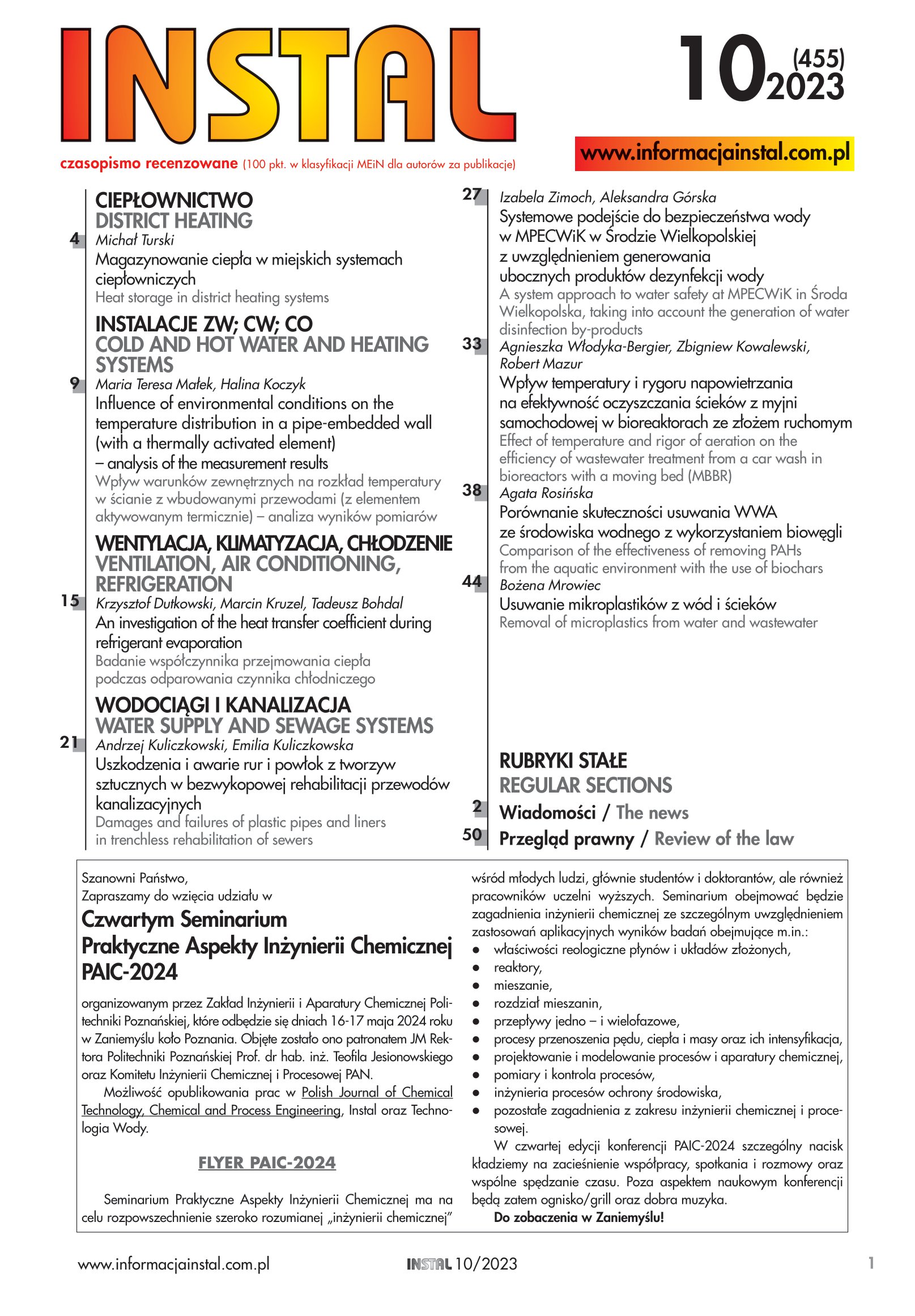
Porównanie skuteczności usuwania WWA ze środowiska wodnego z wykorzystaniem biowęgli
DOI:
https://doi.org/10.36119/15.2023.10.7Słowa kluczowe:
adsorpcja, biowęgiel, osad ściekowy, pomiot kurzy, wielopierścieniowe węglowodory aromatyczne, wodaAbstrakt
Celem badań było porównanie skuteczności usuwania WWA ze środowiska wodnego w wyniku sorpcji na biowęglach otrzymanych z pomiotu kurzego oraz komunalnych osadów ściekowych. Proces sorpcji prowadzono dla dawek biowęgli 50 i 100 mg/l. Dla każdej dawki biowęgla czas kontaktu z WWA wynosił 90 i 120 minut. Najlepsze wyniki uzyskano dla dawki biowęgla 100 mg/l i czasu kontaktu 120 minut. Dla biowęgla z pomiotu kurzego i z osadu ściekowego stężenie benzo(a)pirenu obniżyło się odpowiednio o 87,2 i 78,7% natomiast dla czterech WWA normowanych w wodzie przeznaczonej do spożycia sumaryczne stężenie obniżyło się odpowiednio o 83,5 i 80,2%. Dla pozostałych WWA większą sorpcję zaobserwowano dla dibenzo(a,h)antracenu, stężenie tego związku obniżyło się o 83,2%. Najmniejsze zmiany wykazano dla naftalenu, którego stężenie zmniejszyło się o 68,5%. Nie wykazano istotnych statystycznie różnic pomiędzy sorpcją na biowęglu z pomiotu kurzego i osadu ściekowego.
Pobrania
Bibliografia
Grmasha R., Abdulameer M.H., Stenger-Kovács C., Al-sareji O.J., Al-Gazali Z., Al-Juboori R.A., Meiczinger M., Hashim K.S., Polycyclic aromatic hydrocarbons in the surface water and sediment along Euphrates River system: Occurrence, sources, ecological and health risk assessment, Marine Pollution Bulletin, 187(2023), 114568. https://doi.org/10.1016/j.marpolbul.2022.114568.
Manoli E., Samara C., Polycyclic aromatic hydrocarbons in natural waters: sources, occurrence and analysis, TrAC Trends in Analytical Chemistry, 18(1999), 417-428. https://doi.org/10.1016/S0165-9936(99)00111-9.
Zhang Z.L., Hong H.S., Zhou J.L., Yu G., Phase association of polycyclic aromatic hydrocarbons in the Minjiang river Estuary, China. Sci. Total Environ., 323(2004), 71-86. DOI: 10.1016/j.scitotenv.2003.09.026
Pobrania
Opublikowane
Licencja

Utwór dostępny jest na licencji Creative Commons Uznanie autorstwa 4.0 Międzynarodowe.
Authors retain copyright and grant the journal the right of first publication, with the work simultaneously licensed under a Creative Commons Attribution 4.0 International License, which permits others to share the work with appropriate acknowledgment of the authorship and initial publication in this journal.