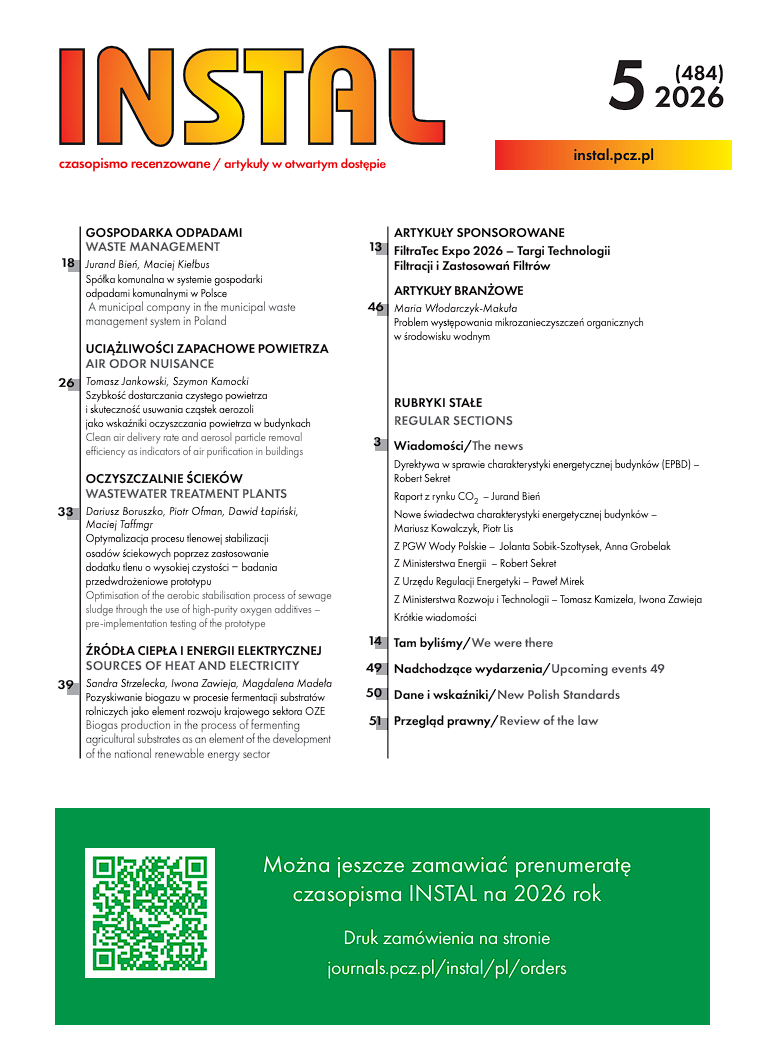
Szybkość dostarczania czystego powietrza i skuteczność usuwania cząstek aerozoli jako wskaźniki oczyszczania powietrza w budynkach
DOI:
https://doi.org/10.17512/instal.2026.05.02Słowa kluczowe:
zanieczyszczenia powietrza, jakość powietrza w pomieszczeniach, oczyszczacze powietrza, komora laboratoryjnaAbstrakt
Jakość powietrza wewnętrznego w budynkach jest ściśle powiązana z eliminowaniem źródeł zanieczyszczeń powietrza oraz regulowaniem stężenia szkodliwych czynników chemicznych, pyłowych i biologicznych w poszczególnych pomieszczeniach. istotną rolę w poprawie jakości powietrza mogą odgrywać wentylacja i klimatyzacja. W przypadku gdy pomieszczenia są słabo wentylowane, rozwiązaniem może być zastosowanie oczyszczaczy powietrza. Wysokie oczekiwania użytkowników oraz szeroki wybór oczyszczaczy powietrza dostępnych na rynku determinują konieczność oceny skuteczności urządzeń do oczyszczania powietrza, zarówno projektowanych, jak i już użytkowanych, w warunkach rzeczywistych, na rynku krajowym i międzynarodowym. W badaniach potwierdzono, że oczyszczacze powietrza mogą oczyszczać powietrze zgodnie z wyznaczonym parametrem CADR w stabilnych warunkach otoczenia, a także umożliwiają obniżenie stężenia pyłów zawieszonych PM10, PM2,5, PM1 oraz cząstek ultradrobnych, poniżej 700 nm, w rzeczywistych i zmiennych warunkach środowiskowych pomieszczeń przeznaczonych na pobyt ludzi.
Pobrania
Bibliografia
Chudzińska A., Smog: architektoniczne metody przeciwdziałania, „Builder”, 1(26), s. 28-31, 2022, DOI: 10.5604/01.3001.0015.5969.
Adamkiewicz Ł.; Kryza M.; Mucha D.; Werner, M; Gayer, A.; Drzeniecka-Osiadacz A.; Sawiński T. Estimating Health Impacts Due to the Reduction of Particulate Air Pollution from the Household Sector Expected under Various Scenarios. Appl. Sci. 2021, 11, 272. https://doi.org/10.3390/app11010272
Afshari A., Mo J., Tian E., Seppänen O., Testing Portable Air Cleaning Units: Test Methods and Standards. A Critical Review, „REHVA Journal”, 59(3), s. 35-46, 2022.
J. Niu, T.C.W. Tung, V.W.Y. Chui, Using large environmental chamber technique for gaseous contaminant removal equipment test/discussion, ASHRAE Trans. 104 (1998) 1289.
W.W. Nazaroff, Effectiveness of air cleaning technologies, in: Healthy Buildings, Helsinki, 2000: pp. 49–54.
S. Miller-Leiden, C. Lohascio, W.W. Nazaroff, J.M. Macher, Effectiveness of In-room air filtration and dilution ventilation for tuberculosis infection control, J Air Waste Manage Assoc 46 (1996), https://doi.org/10.1080/10473289.1996.10467523.
J.A. Siegel, Primary and secondary consequences of indoor air cleaners, Indoor. Air. 26 (2016), https://doi.org/10.1111/ina.12194.
National Standard of the People’s Republic of China, Air Cleaner (GB/T 18801-2015), 2015. https://gbstandards.org/GB_standard_english.asp?code=GB/T%2018801-2015 (accessed March 31, 2024).
Z.M. Sultan, G.M. Nilsson, R.J. Magee, J.S. Bradley, Method for testing portable air cleaners, 2011. https://doi.org/https://doi.org/10.4224/20374076.
J. Pei, W. Dai, H. Li, J. Liu, Laboratory and field investigation of portable air cleaners’ long-term performance for particle removal to be published in: building and environment, Build. Environ. 181 (2020) 107100, https://doi.org/10.1016/j.buildenv.2020.107100.
J.H. Lee, M. Rounds, F. McGain, R. Schofield, G. Skidmore, I. Wadlow, K. Kevin, A. Stevens, C. Marshall, L. Irving, M. Kainer, K. Buising, J. Monty, Effectiveness of portable air filtration on reducing indoor aerosol transmission: preclinical observational trials, J. Hospit. Infect. 119 (2022), https://doi.org/10.1016/j.jhin.2021.09.012.
F.T. Lu, R.J. Laumbach, A. Legard, N.T. Myers, K.G. Black, P. Ohman-Strickland, S. Alimokhtari, A. de Resende, L. Calderón, G. Mainelis, H.M. Kipen, Real-world effectiveness of portable air cleaners in reducing home particulate matter concentrations, „Aerosol and Air Quality Research”, 24, 2024, 230202, https://doi.org/10.4209/aaqr.230202.
J. Cox, K. Isiugo, P. Ryan, S.A. Grinshpun, M. Yermakov, C. Desmond, R. Jandarov, S. Vesper, J. Ross, S. Chillrud, K. Dannemiller, T. Reponen, Effectiveness of a portable air cleaner in removing aerosol particles in homes close to highways, Indoor. Air. 28 (2018), https://doi.org/10.1111/ina.12502.
A. Wheeler, F. Reisen, C. Roulston, M. Dennekamp, N. Goodman, F. Johnston, Evaluating portable air cleaner effectiveness in residential settings to reduce exposures to biomass smoke resulting from prescribed burns, Public Health Res. Pract. 34 (2024), https://doi.org/10.17061/phrp33232307.
P. Barn, T. Larson, M. Noullett, S. Kennedy, R. Copes, M. Brauer, Infiltration of forest fire and residential wood smoke: an evaluation of air cleaner effectiveness, J. Expo Sci. Environ. Epidemiol. 18 (2008) 503–511, https://doi.org/10.1038/sj.jes.7500640.
G. Cortellessa, C. Canale, L. Stabile, G. Grossi, G. Buonanno, F. Arpino, Effectiveness of a portable personal air cleaner in reducing the airborne transmission of respiratory pathogens, Build. Environ. 235 (2023), https://doi.org/10.1016/j.buildenv.2023.110222.
Z. Li, X. Ma, Y. Liao, Combined performance of upper-room UVGI and ceiling-mounted air cleaners for removing active bioaerosol, Build. Environ. 267 (2025) 112230, https://doi.org/10.1016/j.buildenv.2024.112230.
[18] B. Mølgaard, A.J. Koivisto, T. Hussein, K. Hameri, A new clean air delivery rate test applied to five portable indoor air cleaners, „Aerosol Science and Technology”, 48, 2014, https://doi.org/10.1080/02786826.2014.883063.
X. Zhu, M. Lv, X. Yang, A test-based method for estimating the service life of adsorptive portable air cleaners in removing indoor formaldehyde, Build. Environ. 154 (2019) 89–96, https://doi.org/10.1016/j.buildenv.2019.03.018.
H.-J. Kim, B. Han, Y.-J. Kim, Y.-H. Yoon, T. Oda, Efficient test method for evaluating gas removal performance of room air cleaners using FTIR measurement and CADR calculation, Build. Environ. 47 (2012) 385–393, https://doi.org/10.1016/j.buildenv.2011.06.024.
ANSI/AHAM AC-1-2020. Method for Measuring Performance of Portable Household Electric Room Air Cleaners.
AHAM AC-3-2009 (R2021) Method for Measuring the Performance of Portable Household Electric Room Air Cleaners Following Accelerated Particulate Loading, 2009.
PN-EN IEC 63086-1:2021-01/A1:2024-04. Elektryczne urządzenia do oczyszczania powietrza do użytku domowego i podobnego -- Metody badań cech funkcjonalnych -- Część 1: Wymagania ogólne.
PN-EN IEC 63086-2-1:2024-10. Elektryczne urządzenia do oczyszczania powietrza do użytku domowego i podobnego -- Metody badań cech funkcjonalnych -- Część 2-1: Wymagania szczegółowe dotyczące pomiaru redukcji cząstek stałych.
Jankowski T. Metody oczyszczania powietrza w pomieszczeniach budynków. Inżynier Budownictwa, 2(235), 76-80, 2025
Opublikowane
Licencja
Prawa autorskie (c) 2026 Tomasz Jankowski, Szymon Kamocki (Autor)

Utwór dostępny jest na licencji Creative Commons Uznanie autorstwa 4.0 Międzynarodowe.
Authors retain copyright and grant the journal the right of first publication, with the work simultaneously licensed under a Creative Commons Attribution 4.0 International License, which permits others to share the work with appropriate acknowledgment of the authorship and initial publication in this journal.