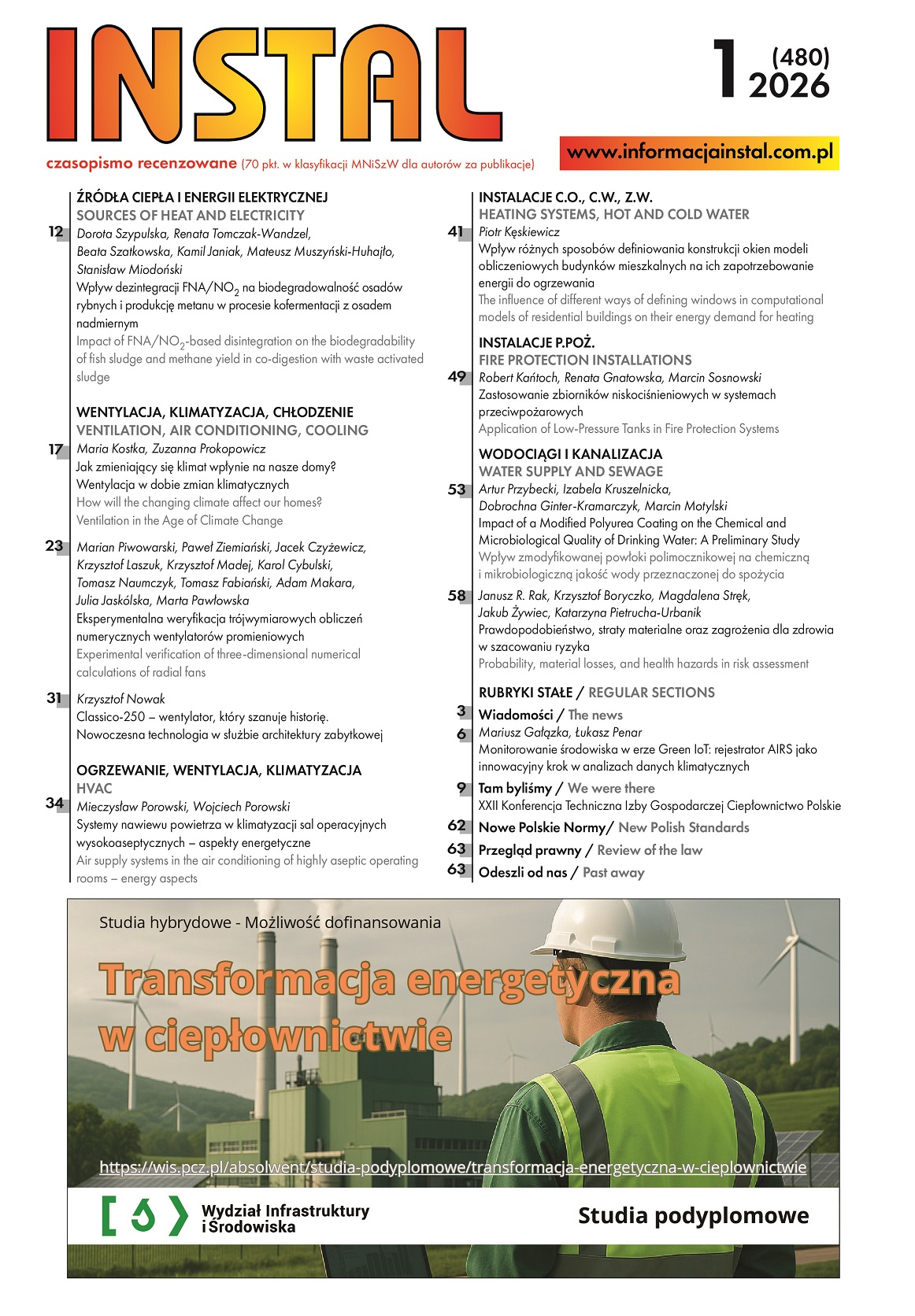
Wpływ różnych sposobów definiowania konstrukcji okien modeli obliczeniowych budynków mieszkalnych na ich zapotrzebowanie energii do ogrzewania
DOI:
https://doi.org/10.36119/15.2026.1.5Słowa kluczowe:
zużycie energii, symulacje energetyczne, dokładność obliczeń, jakość modelu, udział przeszkleniaAbstrakt
W artykule przedstawiono analizę wpływu różnego sposobu i dokładności definiowania konstrukcji okien, przy tworzeniu modelu obliczeniowego budynku jednorodzinnego, na uzyskiwane wyniki symulacji zużycia energii instalacji centralnego ogrzewania budynku. Obliczenia przeprowadzono na podstawie typowego dla warunków polskich budynku jednorodzinnego o minimalnej oraz zalecanej powierzchni przeszkleń, w programie symulacyjnym EDSL TAS. Ostatecznie uwzględniono cztery różne metody definiowania konstrukcji okien możliwe do zastosowania w programie, wprowadzenie: stałej grubości ramy okna, procentowego udziału przeszklenia do całkowitej powierzchni zaczerpniętego z literatury i określonego na podstawie rzeczywistej konstrukcji dobranych okien, możliwie wiernego odwzorowania szczegółów konstrukcji dobranych okien. Wyniki przedstawiono całościowo dla analizowanego budynku, indywidualnie dla poszczególnych pomieszczeń oraz szczegółowo dla pomieszczenia o największym przeszkleniu.
Pobrania
Bibliografia
[1] Kajewska-Szkudlarek J., Stańczyk J., Domańska M.; Modelowanie zużycia energii na cele c.o. i c.w. w budynkach wielorodzinnych na tle sytuacji meteorologicznej we Wrocławiu; Instal 5/2024; s. 10-16; DOI 10.36119/15.2024.5.2
[2] Karta techniczna – Okna PVC PRIMO 82; WIŚNIOWSKI Sp. z o.o. S.K.A.; Wielopole 2020
[3] Kendrick Ch., Ogden R., Wang X., Baiche B; Thermal mass in new build UK housing: A comparison of structural systems in a future weather scenario; Energy and Buildings; Volume 48, 2012; s. 40-49; https://doi.org/10.1016/j.enbuild.2012.01.009
Opublikowane
Licencja

Utwór dostępny jest na licencji Creative Commons Uznanie autorstwa 4.0 Międzynarodowe.
Authors retain copyright and grant the journal the right of first publication, with the work simultaneously licensed under a Creative Commons Attribution 4.0 International License, which permits others to share the work with appropriate acknowledgment of the authorship and initial publication in this journal.