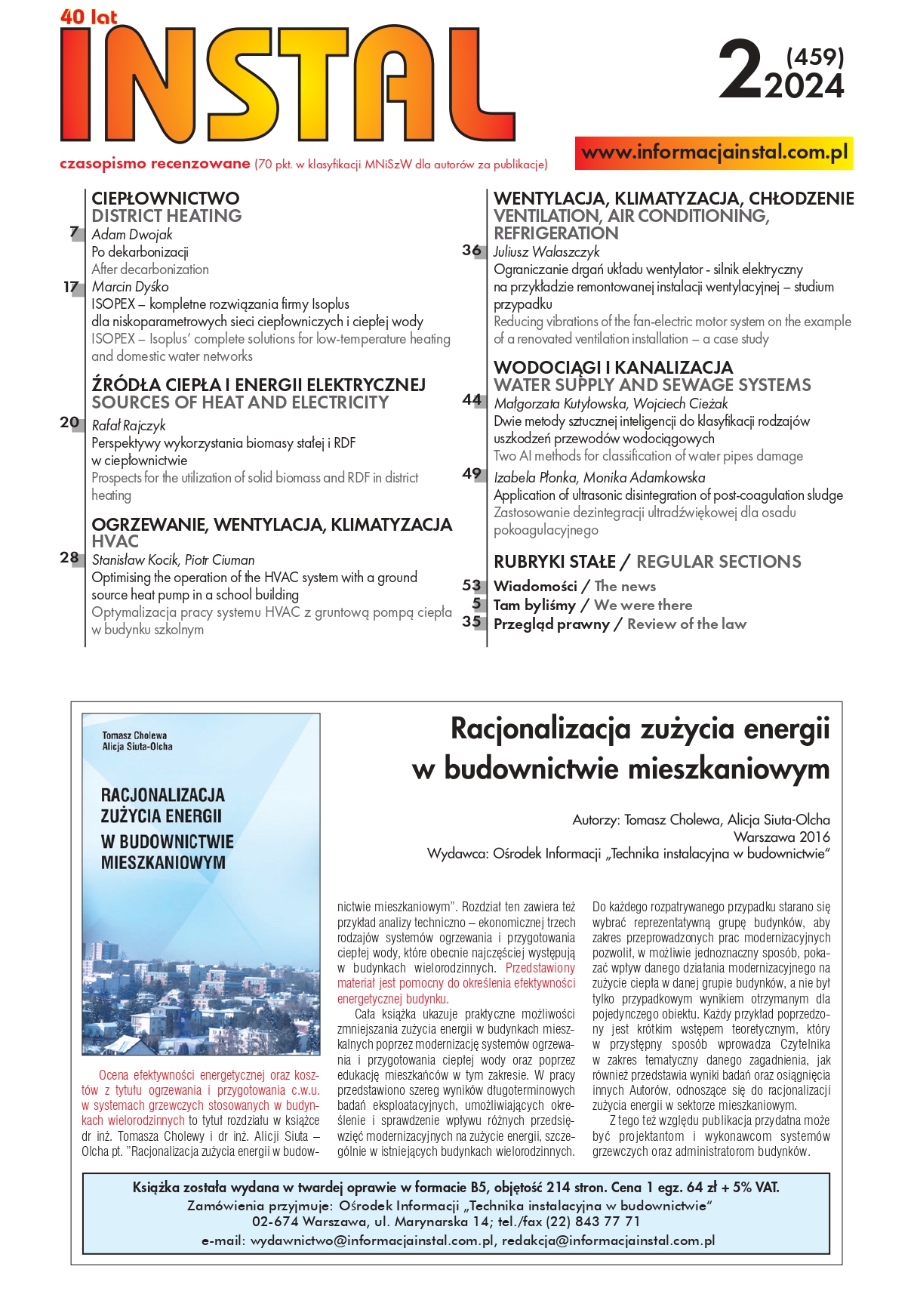
Zastosowanie dezintegracji ultradźwiękowej dla osadu pokoagulacyjnego
DOI:
https://doi.org/10.36119/15.2024.2.6Słowa kluczowe:
dezintegracja ultradźwiękowa, osady pokoagulacyjne, osady z produkcji wodyAbstrakt
Dezintegracja osadu jest procesem polegającym na zniszczeniu struktury kłaczków osadu, a następnie rozerwaniu błony komórkowej i lizie komórek drobnoustrojów. Procesy dezintegracji to obecnie dynamicznie rozwijające się technologie, które cieszą się coraz większym zainteresowaniem. Zastosowanie procesu dezintegracji skutkuje między innymi zerwaniem silnych wiązań chemicznych, dlatego może być skuteczny w przypadku osadów pokoagulacyjnych. Dla tego typu osadów oczekiwanym efektem jest poprawa ich właściwości filtracyjnych. Zintegrowane działanie mikroorganizmów i samych komórek powoduje uwolnienie materii organicznej i wody biologicznej z wnętrza komórki. Procesy dezintegracji osadów można przeprowadzić przy pomocy technik: mechanicznej, termicznej, chemicznej lub biologicznej. Wybór danej metody nie jest prosty, gdyż efekty zależą od wielu parametrów. Jedną z metod dezintegracji są ultradźwięki. Ultradźwięki mogą negatywnie wpływać na organizmy żywe. Oddziałując bezpośrednio na komórki ścian i błon, prowadzą do ich deformacji, perforacji lub śmierci komórek. W badanym osadzie pokoagulacyjnym przed i po procesie dezintegracji wykonano oznaczenia: czas ssania kapilarnego (CSK), zawartość suchej masy (SM), zawartość suchej masy organicznej (SMorg), uwodnienie, oraz ChZT cieczy nadosadowej. Po procesie dezintegracji zaobserwowano, że wartość SM wzrosła od 0,04 % do 0,06% w przypadku najdłuższego czasu ekspozycji osadu na działanie ultradźwięków. Zaobserwowano również, że im dłuższy czas naświetlania, tym wyższa wartość ChZT cieczy. Natomiast czas ssania kapilarnego uległ skróceniu z 53 s dla osadu
niedezintegrowanego do 25 s dla osadu poddanego nadźwiękawianiu – amplituda 50%, czas10 min. Świadczy to o poprawie właściwości filtracyjnych osadu po procesie dezintegracji.
Pobrania
Bibliografia
Serzyna S. Możliwość wykorzystania osadów powstających podczas oczyszczania wody. Interdyscyplnarne zagadnienia w inżynierii i ochronie środowiska. Oficyna Wyd. Politechniki Wrocławskiej. Wrocław; 2013; 609-617.
Knycl M, Cihalova S, Jurkova M, Langarova S. Disposal and Reuse of the Water Processing Sludge. Journal of the Polish Mineral Engineering Society. 2012; 11-20.
Łukasiewicz E. Post-coagulation sludge management for water and wastewater treatmentwith focus on limiting its impact on the enviroment. Economic and Environmental Studies. 2016; 16,(4): 831-841.
Ahmad T, Ahmad K, Alam M. Characterization of water treatment Plant’s sludge and its safe disposal options. Procedia Environ Sci. 2016; 35: 950-955. DOI: 10.1016/j.proenv.2016.07.088
Pobrania
Opublikowane
Licencja

Utwór dostępny jest na licencji Creative Commons Uznanie autorstwa 4.0 Międzynarodowe.
Authors retain copyright and grant the journal the right of first publication, with the work simultaneously licensed under a Creative Commons Attribution 4.0 International License, which permits others to share the work with appropriate acknowledgment of the authorship and initial publication in this journal.